

The Complete JAMB Admission Process Guide for 2026 Candidates
Some students begin checking CAPS before they even finish eating breakfast. Others stay awake refreshing school portals long after midnight during the JAMB Admission Process 2026, afraid they may miss an important update.
For many Nigerian families, admission season feels less like a simple academic process and more like a long emotional waiting room — full of uncertainty, rumors, pressure, and endless online speculation. One week, social media says admissions have started. Another week, students begin hearing rumors that institutions have changed their cut-off marks or stopped offering admission entirely. Some candidates repeatedly refresh portals late at night, hoping for updates, while others begin to doubt themselves after seeing classmates celebrate their admissions online.
In reality, the Nigerian admission system is far more gradual and competitive than many people initially expect.
Every year, millions of candidates apply for admission through the Joint Admissions and Matriculation Board (JAMB), yet the number of available university spaces remains far lower than the number of applicants. This pressure has also created a growing ecosystem of misinformation, fake admission updates, fraudulent agents, and social media panic.
That is why understanding how the admission process truly works has become increasingly important.
This guide explains the complete JAMB admission process for 2026 candidates in a calm, realistic, and practical manner. Rather than focusing on fear or exaggerated promises, the article breaks down what students and families should genuinely expect — from registration and screening to CAPS processing, admission batches, and common mistakes that quietly affect many candidates every year.
Whether you are preparing for admission yourself or helping a child or relative navigate the process, understanding how the system works can help reduce confusion, avoid costly errors, and improve decision-making throughout admission season.

Table of Contents
What Is JAMB and Why Does It Matter?
The Joint Admissions and Matriculation Board (JAMB) is the central examination body responsible for coordinating admissions into most tertiary institutions in Nigeria. Students are usually advised to verify updates directly through the official JAMB portal and approved institutional channels whenever possible. This includes federal universities, state universities, polytechnics, colleges of education, and several other accredited institutions.
For most students seeking higher education in Nigeria, JAMB serves as the primary gateway into the admission system.
Over the years, the organization has become deeply integrated into how tertiary institutions process applications, verify candidate eligibility, and manage admissions nationwide.
What Is UTME?
The Unified Tertiary Matriculation Examination (UTME) is the computer-based examination most candidates write after secondary school when applying for tertiary education.
Candidates select:
- their preferred institutions,
- intended courses of study,
- and four examination subjects related to their chosen discipline.
The UTME score later becomes one of the major factors institutions consider during admission processing.
However, many candidates mistakenly assume that scoring high automatically guarantees admission.
That is not always the case.
What Is Direct Entry?
Direct Entry is designed for candidates who already possess advanced qualifications beyond regular secondary school results.
This pathway is commonly used by:
Instead of applying through the regular UTME pathway, Direct Entry candidates may gain admission into higher levels depending on institutional policies and qualifications.
Why JAMB Is Central to Nigerian Admissions
Even though universities conduct their own internal screening processes, JAMB still coordinates major aspects of admission nationwide.
These include:
- candidate registration,
- score processing,
- admission eligibility,
- CAPS management,
- and admission confirmation.
Without proper JAMB processing, many admissions cannot be finalized officially.
This is one reason candidates are repeatedly advised to monitor both school portals and JAMB platforms carefully.
Why JAMB Scores Alone Do Not Guarantee Admission
A common misunderstanding among candidates is the belief that scoring above the general cut-off mark automatically secures admission.
In practice, the process is more competitive.
For example, a candidate may score above a university’s minimum cut-off mark and still not gain admission because thousands of other candidates applied for the same course.
Highly competitive departments such as:
- Medicine,
- Nursing,
- Pharmacy,
- Law,
- and Engineering,
often receive far more applications than available spaces.
This means institutions usually consider multiple factors beyond the raw JAMB score alone.
One Important Thing To Understand
JAMB remains the gateway into most Nigerian tertiary institutions, but scores alone rarely determine final outcomes. There are usually several quieter layers behind every final decision.
How Competitive Admission Has Become in Nigeria
Admission competition in Nigeria has become increasingly intense over the years.
One major reason is simple: the number of candidates seeking university admission continues growing faster than the number of available spaces.
In recent years, millions of candidates have registered annually for JAMB examinations across the country. However, institutional capacity has not expanded at the same pace.
As a result, many universities — especially federal institutions — experience enormous admission pressure every admission cycle.
Why Millions Compete for Limited University Spaces
For many Nigerian families, university education remains one of the most important pathways toward career growth and social mobility.
This means a very large number of candidates often target a relatively small number of reputable institutions.
Federal universities especially tend to attract heavy application volumes because they are generally:
- more affordable,
- more established,
- and often perceived as more competitive academically.
This pressure naturally increases admission difficulty.
Why Competitive Courses Have Extremely Limited Slots
| Course | Competition Level | Why It Is Highly Competitive |
|---|---|---|
| Medicine and Surgery | Extremely High | Limited clinical spaces, high demand, strict accreditation quotas |
| Nursing | Very High | Growing healthcare demand and limited departmental capacity |
| Law | Very High | High application volume and limited admission slots |
| Pharmacy | Very High | Strict laboratory and accreditation requirements |
| Computer Science | High | Rising technology career demand and increasing applications |
| Engineering | High | Infrastructure and laboratory limitations |
Not all departments can admit large numbers of students.
Certain courses operate under strict accreditation and infrastructure limitations.
Departments may be restricted by:
- laboratory availability,
- clinical facilities,
- staffing levels,
- classroom capacity,
- or professional accreditation requirements.
As a result, institutions sometimes admit only a relatively small number of students into particular programs each year.
Why Medicine, Nursing, Pharmacy and Law Are More Competitive
Courses like Medicine, Nursing, Pharmacy, and Law often experience extremely high demand nationwide.
Thousands of candidates may apply for these programs within the same institution.
In some cases, only a small percentage of applicants eventually secure admission.
This explains why candidates sometimes become shocked after scoring relatively high marks but still failing to gain admission.
The issue is not always poor performance.
Sometimes, the competition level itself is extraordinarily high.
Why High Scores Still May Not Guarantee Admission
Admission decisions are influenced by several factors working together.
These may include:
- departmental quotas,
- catchment policies,
- O’Level requirements,
- post-UTME performance,
- and institutional admission priorities.
A candidate who scores 250 in one course may still face heavier competition than another candidate who scores lower in a less competitive department.
This is one reason many experienced education counselors encourage candidates to think strategically when selecting institutions and courses.
Why This Matters
Competition for higher education in Nigeria has increased sharply over the years because the number of people seeking university spaces now far exceeds available capacity in many schools.
How the Nigerian Admission Process Actually Works
Many candidates understand individual parts of the admission process but struggle to see how the entire system connects together.
This confusion often creates unnecessary anxiety.
In reality, the admission journey usually follows a gradual sequence.
While procedures may vary slightly between institutions, the general process often looks like this:
- JAMB registration
- UTME examination
- Result release
- O’Level verification
- Post-UTME or screening
- CAPS processing
- Admission batches
- Admission acceptance
- Clearance and documentation
Understanding this sequence helps candidates avoid panic during periods when updates appear slow.
Why Admission Processing Sometimes Takes Months
Admission processing in Nigeria is rarely immediate.
Institutions often review:
- thousands of applications,
- screening records,
- departmental quotas,
- and candidate eligibility requirements.
This process naturally takes time.
Some schools also coordinate approvals across multiple departments before releasing final admission lists.
As a result, candidates may wait several weeks or even months before receiving updates.
Why Institutions Release Admission Lists in Batches
Another major source of confusion is batch admission processing.
Many universities do not release all admissions at once.
Instead, they may publish:
- first batch,
- second batch,
- supplementary lists,
- or departmental updates gradually.
This often explains why one candidate receives admission earlier while another candidate from the same institution continues waiting.
Why Candidates Frequently Panic During Admission Season
The uncertainty surrounding admissions can create enormous emotional pressure.
Some candidates repeatedly refresh CAPS or school portals every day.
Others begin assuming something is wrong when classmates start posting admission screenshots online.
In reality, institutions process admissions differently.
A candidate may remain without updates for weeks and still eventually gain admission later.
This is why relying on verified institutional communication is far more important than following social media rumors.
Quiet Reality
The process is usually slower and more layered than many young people initially expect. Sometimes the waiting itself becomes part of the emotional challenge.
How To Register for JAMB Properly
Deadline Warning: Many young Nigerians lose opportunities quietly every year simply because correction deadlines or screening windows passed unnoticed.
Many admission complications actually begin during registration.
Simple mistakes made early can later create frustrating problems during screening or CAPS processing.
That is why candidates should approach registration carefully rather than rushing through the process.
Documents Needed for Registration
Candidates are usually expected to prepare:
- National Identification Number (NIN),
- valid phone number,
- active email address,
- personal details,
- and educational records.
Using an active and accessible email address is especially important because many institutions later communicate important updates electronically.
How To Choose the Right Institution
Institution selection should not be based entirely on peer pressure or popularity.
Some candidates simply copy the choices of friends without properly evaluating:
- admission competitiveness,
- course requirements,
- institutional strengths,
- or realistic chances of admission.
Strategic decision-making matters.
Choosing institutions that align with both performance level and career goals can sometimes improve admission opportunities significantly.
Common Registration Errors That Affect Admission Later
Some of the most common registration mistakes include:
- wrong subject combinations,
- incorrect email addresses,
- spelling errors,
- inconsistent names,
- and inaccurate course selections.
Unfortunately, some candidates only discover these issues much later when screening begins.
Correcting such mistakes afterward can become stressful and time-consuming.
Critical Registration Deadlines Candidates Commonly Miss
Every admission season includes important deadlines.
These may involve:
- registration windows,
- correction periods,
- profile updates,
- or institution change opportunities.
Candidates who delay action unnecessarily sometimes lose valuable opportunities simply because deadlines passed quietly.
Quiet Reality
A surprising number of problems actually begin with small registration errors that initially seem harmless.
Understanding Subject Combinations and O’Level Requirements
One of the most common reasons candidates encounter admission problems is the failure to properly understand subject combinations and O’Level requirements.
Many students focus heavily on their UTME score while paying less attention to whether their selected subjects and O’Level records actually match the requirements for their intended course.
Unfortunately, institutions take these requirements very seriously.
A strong score alone may not compensate for incorrect subject combinations or incomplete O’Level records.
Correct Subject Combinations for Popular Courses
Every course requires specific UTME subjects.
For example:
- Medicine usually requires English, Biology, Chemistry, and Physics.
- Law often requires English, Literature, and relevant arts or social science subjects.
- Engineering courses typically require Mathematics, Physics, and Chemistry.
Candidates who select incorrect combinations may later discover they do not meet admission eligibility requirements.
This is one reason students should always confirm official course requirements before registration.
Why Wrong Subject Combinations Can Block Admission
Some candidates only discover subject combination problems after screening begins.
In certain cases, a university may refuse admission completely because required subjects were missing during UTME registration.
This can become especially painful when the candidate has already performed well in the examination itself.
Many experienced admission officers quietly advise students not to assume that “close enough” subject combinations will always be accepted.
Institutions usually follow official departmental requirements carefully.
Can Candidates Combine WAEC and NECO?
Many Nigerian institutions allow candidates to combine WAEC and NECO results, depending on institutional policy and course requirements.
However, candidates should still verify specific institutional rules because some highly competitive departments may impose stricter conditions.
The number of sittings accepted can also vary between institutions.
Why Uploading O’Level Results Late Can Be Risky
Some candidates only realize their O’Level results were never uploaded properly after admission lists begin appearing.
This is more common than many students expect.
A candidate may meet the required score and screening conditions but still experience admission delays because the institution or CAPS cannot verify complete O’Level information.
That is why candidates are often advised to confirm that their results have been uploaded correctly and early enough.
Why This Matters
Strong scores may still become useless if subject combinations or uploaded O’Level records do not align properly with departmental requirements.
What Happens After Writing JAMB?
After the UTME examination, many candidates immediately begin trying to predict their admission chances.
This stage often comes with:
- score comparisons,
- social media debates,
- speculation about cut-off marks,
- and growing anxiety.
However, understanding how institutions actually evaluate candidates can help reduce unnecessary panic.
Difference Between General Cut-Off Marks and Departmental Cut-Off Marks
Many institutions announce a general minimum cut-off mark for eligibility.
But this is not always the same as the departmental requirement.
For example, a university may announce a general cut-off mark of 180 while departments like Medicine or Law quietly require much higher scores because of competition.
This distinction confuses many candidates every year.
Scoring above the general benchmark does not automatically guarantee placement into highly competitive departments.
Why Some High Scores Still Fail To Secure Admission
Several factors may influence admission outcomes beyond raw examination scores.
These may include:
- departmental quotas,
- O’Level performance,
- post-UTME scores,
- catchment policies,
- and institutional priorities.
In some situations, candidates with strong scores still lose admission because available departmental spaces become exhausted.
This can feel unfair emotionally, but it reflects the broader reality of intense admission competition nationwide.
Why Competitive Courses Create Additional Pressure
Courses like:
- Nursing,
- Medicine,
- Pharmacy,
- Computer Science,
- and Law,
often attract extremely high application numbers.
Thousands of candidates may target only a limited number of available spaces.
As a result, admission pressure becomes much heavier within those departments.
This is one reason some experienced counselors encourage candidates to think strategically about institution and course flexibility.
Why This Matters
Competition levels vary heavily between departments. What feels like a strong score in one course may still struggle in another.
What Is Post-UTME and Why Does It Matter?
After JAMB results are released, many institutions begin their internal screening process.
This stage is commonly known as post-UTME or admission screening.
While procedures vary between institutions, the screening stage remains one of the most important parts of the admission process.
Institutions That Conduct Written Post-UTME Exams
Some institutions still organize physical or computer-based post-UTME examinations.
Candidates may be required to:
- register separately,
- pay screening fees,
- upload documents,
- and participate in additional testing.
Performance during this stage can significantly influence final admission decisions.
Institutions That Use Online Screening
Other institutions rely mainly on online screening.
In such cases, universities may evaluate:
- JAMB scores,
- O’Level records,
- age requirements,
- and uploaded credentials.
Even though there may be no written examination, proper documentation still matters greatly.
Common Screening Mistakes Candidates Make
Some of the most common mistakes include:
- uploading incomplete records,
- missing payment confirmation,
- ignoring institutional announcements,
- using incorrect email addresses,
- or waiting too long before completing screening registration.
In some situations, candidates assume screening updates will spread automatically through social media.
That assumption can become risky.
Critical Screening Deadlines Candidates Commonly Miss
Screening deadlines are sometimes shorter than candidates expect.
Some institutions quietly close portals once registration periods end.
Candidates who delay action unnecessarily may later discover they are no longer eligible for consideration.
Some students also miss deadlines after relying entirely on WhatsApp broadcasts or unofficial Telegram groups rather than checking institutional portals directly.
One Important Thing To Understand
Many young applicants focus heavily on JAMB scores but underestimate how important the screening stages can become later.
JAMB CAPS Explained Simply for Nigerian Students
Important Reminder: CAPS updates do not always happen instantly. A delayed update is not automatically a rejection.
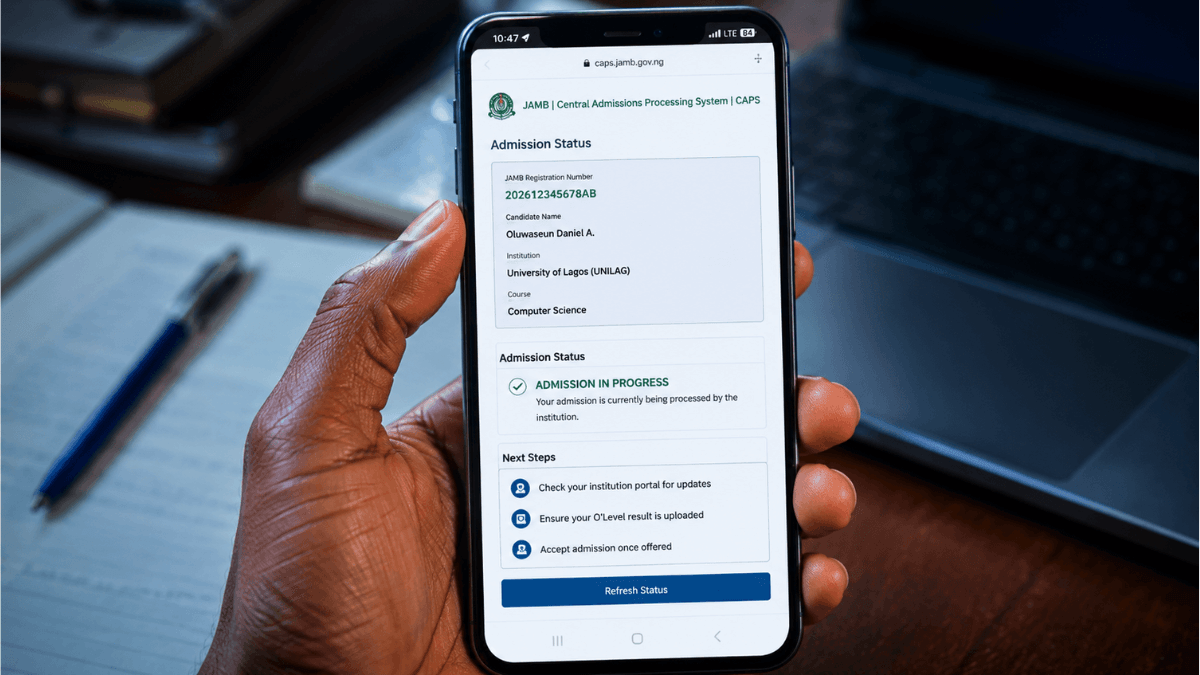
| CAPS Status | What It Usually Means |
|---|---|
| Admission in Progress | The school is still reviewing or processing the application |
| Not Admitted | The process may still continue later depending on the institution |
| Admitted | Admission has been officially offered |
| Transfer Approval | The institution may be recommending a course change |
For many candidates, CAPS is often the most confusing stage of the entire admission process.
The platform regularly creates anxiety because candidates expect immediate updates, while institutions usually process admissions gradually.
Understanding how CAPS works can help reduce unnecessary panic.
CAPS stands for Central Admission Processing System.
It is the official platform used to manage admission processing, recommendations, transfers, and confirmations.
Why Many Candidates Misunderstand CAPS
One major problem is that candidates often expect CAPS to behave like instant messaging platforms.
In reality, institutional processing takes time.
Updates may appear gradually depending on:
- departmental reviews,
- institutional approvals,
- quota balancing,
- and admission batch processing.
Because many students do not fully understand this process, social media speculation spreads quickly.
Meaning of “Admission in Progress”
When CAPS displays “Admission in Progress,” it usually means the institution is still processing the candidate’s admission.
It does not automatically mean rejection.
Many candidates become unnecessarily worried during this stage because they expect immediate final decisions.
Meaning of “Not Admitted”
“Not Admitted” does not always mean the process has ended permanently.
Some institutions continue updating CAPS gradually throughout the admission cycle.
Candidates sometimes move from “Not Admitted” to successful admission later.
That is why experienced education advisers often encourage patience before assuming final rejection.
Why CAPS Sometimes Shows No Update
Some institutions process admissions slowly or upload updates in phases.
This can leave candidates refreshing CAPS repeatedly for weeks.
A student may see no visible update while the institution is still processing internal departmental approvals quietly.
This uncertainty is one reason admission season becomes emotionally stressful for many families.
Why School Portals and CAPS Sometimes Show Different Admission Statuses
A school portal may occasionally display admission before CAPS updates fully.
In other situations, CAPS may update before the school portal changes.
This difference often creates confusion and panic among candidates.
In practice, institutions and CAPS do not always synchronize instantly.
Candidates should avoid rushing into fear-driven conclusions simply because both systems do not update simultaneously.
Critical CAPS Deadlines Candidates Commonly Ignore
Some candidates ignore CAPS completely after screening.
Others fail to accept admission on time after receiving offers.
These mistakes can quietly create serious problems later.
Candidates should monitor CAPS carefully throughout the admission season.
How To Accept or Reject Admission Properly
Once admission appears officially, candidates are usually expected to either:
- accept admission,
- or reject it.
Ignoring this step unnecessarily can create avoidable complications.
Candidates should always verify admission updates through official channels before taking action.
Practical Reminder
CAPS is the official admission management platform used to process and confirm admission offers in Nigeria.
Common Realities Candidates Should Expect During Admission Season

Admission season can become emotionally exhausting for many students.
Even candidates who have prepared seriously sometimes experience:
- uncertainty,
- self-doubt,
- comparison pressure,
- and emotional fatigue.
This emotional side of the admission process is rarely discussed openly, yet it affects many families deeply.
Why Admission Waiting Periods Feel Emotionally Stressful
Waiting without clear updates can create enormous anxiety.
Some candidates begin overanalyzing every rumor or screenshot shared online.
Others start questioning whether they made the right course or institution choices.
The emotional pressure becomes even heavier when classmates begin announcing admissions publicly.
Why Social Media Rumours Spread Quickly During Admission Season
Admission season often creates large volumes of unofficial online information.
WhatsApp broadcasts, Facebook groups, Telegram communities, and TikTok videos sometimes spread inaccurate claims rapidly.
Candidates who rely entirely on such sources may become unnecessarily confused.
In reality, institutions usually communicate important information through official portals and verified announcements.
Why Comparing Yourself With Other Candidates Can Be Harmful
Many candidates begin doubting themselves after seeing others announce admissions online, even when institutions are still processing applications gradually.
This comparison culture quietly increases emotional pressure.
A candidate may assume failure simply because another institution has already released admissions earlier.
However, different schools process admissions at different speeds.
Why Patience Matters More Than Online Panic
One of the most difficult parts of the admission process is learning how to remain calm while updates appear uncertain.
Panic-driven decisions often create more problems.
Some candidates rush into unnecessary course changes, fake upgrade offers, or unverified admission promises simply because they feel emotionally pressured.
Staying patient and following verified procedures usually produces better outcomes than reacting emotionally to online rumors.
Why This Matters
During admission season, even confident students sometimes begin questioning themselves. That emotional pressure is more common than many people openly admit.
How Parents and Guardians Can Support Candidates During Admission Processing
Admission pressure rarely affects candidates alone.
In many Nigerian families, the entire household experiences emotional tension during admission season.
Parents, guardians, relatives, and sponsors often become deeply invested in the outcome.

Why Admission Anxiety Affects Entire Families
Families sometimes feel helpless watching candidates wait for updates over long periods.
Repeated uncertainty can create frustration and emotional exhaustion for both students and parents.
This pressure occasionally leads to panic-driven decisions or overreactions.
How Parents Can Help Candidates Stay Calm
One of the most valuable things families can provide during admission season is emotional stability.
Candidates often benefit from:
- reassurance,
- patience,
- calm communication,
- and realistic expectations.
Excessive pressure or constant comparison may worsen anxiety unnecessarily.
How Families Can Avoid Admission Fraudsters
Fraudsters often target emotionally vulnerable families during admission season.
Some scammers promise:
- guaranteed admission,
- CAPS upgrades,
- special connections,
- or secret institutional influence.
Families should remain cautious whenever payments or unofficial promises appear suspicious.
Why Comparing Candidates Creates Unnecessary Pressure
Many families unintentionally increase emotional pressure by constantly comparing students.
Statements like:
- “Your friend already gained admission,”
- or “Others have moved ahead,”
may deepen anxiety unnecessarily.
Admission timelines differ between institutions and departments.
Patience remains important.
What Many Families Don’t Realize
Sometimes, calm reassurance from family members matters more than constant pressure for quick updates.
Why Universities Cannot Admit Every Qualified Candidate
One painful reality many Nigerian candidates eventually encounter is this:
not every qualified student will receive admission.
For many families, this can feel difficult to understand emotionally.
A candidate may meet the cut-off mark, complete screening properly, and still fail to gain admission.
In many situations, the issue is not necessarily poor performance.
The larger problem is that institutional capacity remains limited.
What Admission Quotas Mean
Universities operate under admission quotas approved through accreditation and regulatory processes. Many of these limitations are tied to accreditation standards monitored by regulatory bodies such as the National Universities Commission (NUC).

This means departments are often restricted to admitting only a certain number of students within each admission cycle.
Even when many candidates perform well, available spaces may still remain limited.
Why Some Departments Admit Very Few Students
Some departments require:
- specialized laboratories,
- clinical equipment,
- practical facilities,
- or intensive supervision.
As a result, institutions may intentionally limit student intake to maintain accreditation standards.
Courses such as:
- Medicine,
- Nursing,
- Pharmacy,
- and Engineering,
are often affected heavily by these realities.
Why Federal Universities Face Intense Pressure
Federal universities typically attract enormous application volumes nationwide.
Many candidates see them as:
- more affordable,
- more established,
- and more competitive academically.
This creates heavy pressure on available spaces.
In some institutions, thousands of candidates may compete for only a relatively small number of departmental slots.
Why Admission Feels Increasingly Difficult for Many Nigerian Students
For many young Nigerians, admission now feels more emotionally demanding than it did years ago.
Growing candidate numbers, rising educational expectations, economic realities, and limited institutional expansion have all contributed to increased pressure.
This is one reason many students experience frustration even after performing reasonably well academically.
Why Some Qualified Candidates Still Lose Admission
Sometimes, qualified candidates lose admission simply because the number of eligible applicants exceeds departmental capacity.
This can feel discouraging emotionally.
However, understanding these structural realities can help candidates make more strategic decisions rather than assuming every rejection reflects personal failure.
Why This Matters
Not every rejection reflects failure. In many situations, space limitations quietly shape outcomes long before final lists appear publicly.
The Most Common Admission Mistakes Students Make Every Year
| Common Mistake | Possible Consequence |
|---|---|
| Ignoring CAPS updates | Missing important admission actions or deadlines |
| Uploading incorrect O’Level results | Admission delay or screening disqualification |
| Using wrong subject combinations | Loss of eligibility for intended course |
| Missing screening deadlines | Loss of admission consideration |
| Following social media rumours | Panic-driven decisions and misinformation |
| Delaying institution or course changes | Reduced admission opportunities later |
Many admission failures are not caused by poor academic performance alone.
In reality, avoidable procedural mistakes quietly affect large numbers of candidates every admission season.
Some of these mistakes may appear small initially but later create serious complications.
Ignoring CAPS Updates
Some candidates stop checking CAPS completely after screening.
Others assume institutions will automatically complete every process without requiring candidate action.
In certain cases, candidates only realize much later that admission acceptance or updates required attention earlier.
Uploading Incorrect O’Level Results
Incorrect uploads, incomplete records, or unverified results can delay admission processing.
Some candidates discover these problems only after admission lists begin appearing.
This is one reason early verification matters.
Using Wrong Subject Combinations
Even candidates with strong scores may encounter eligibility problems if their subject combinations do not align properly with departmental requirements.
Many candidates underestimate how seriously institutions evaluate these combinations.
Missing Screening Deadlines
Some institutions close screening portals quietly once deadlines pass.
Candidates who delay action unnecessarily sometimes lose consideration completely.
Others assume there will always be deadline extensions.
That assumption can become risky.
Following Unverified Social Media Advice
Social media discussions can become overwhelming during admission season.
Unfortunately, not every viral update or forwarded message is accurate.
Some candidates make major decisions based entirely on rumors shared online.
Official institutional communication should always carry greater priority.
Waiting Too Long To Process Changes
Some candidates delay:
- institution changes,
- course changes,
- or correction procedures,
until options become limited.
In some situations, acting earlier could have improved admission opportunities significantly.
Why This Matters
Some of the most painful setbacks begin with very small oversights that people initially ignore.
How Nigerian Students Can Avoid Admission Scams in 2026
Scam Warning: No legitimate official can secretly guarantee admission in exchange for hidden payments or private transfers.
| Scam Warning Sign | Why It Is Dangerous |
|---|---|
| Guaranteed admission promises | Legitimate admission cannot be secretly guaranteed unofficially |
| Requests for urgent secret payments | Fraudsters exploit emotional pressure and urgency |
| Fake CAPS upgrade offers | Unauthorized score or CAPS manipulation claims are major red flags |
| Suspicious admission websites | Fake portals may steal personal information or payment details |
| Unofficial WhatsApp or Telegram groups | Many spread false updates and fraudulent instructions |
| Pressure to act immediately without verification | Scammers rely heavily on panic and emotional reactions |
Admission season has increasingly become a target period for online fraud and social engineering scams.
Scammers often take advantage of:
- emotional pressure,
- admission anxiety,
- desperation,
- and misinformation.
That is why candidates and families should remain cautious throughout the admission cycle.
Fake Admission Agents
Some fraudsters claim to possess:
- special institutional connections,
- insider influence,
- or guaranteed admission access.
In many cases, they demand large payments while offering unrealistic promises.
Candidates should remain careful whenever someone guarantees admission unofficially.
Fake WhatsApp Admission Groups

Some WhatsApp groups spread:
- false admission updates,
- fake payment instructions,
- or misleading CAPS information.
Because these groups often appear active and convincing, some candidates mistakenly assume they are official.
Institutions rarely rely on random WhatsApp groups for critical admission communication.
Fake Telegram and Facebook Admission Communities
Telegram channels and Facebook communities have also become common environments for admission misinformation.
Some pages impersonate institutions or create fake urgency around:
- screening payments,
- admission upgrades,
- or portal access.
Candidates should verify information carefully before responding to online instructions.
Fake JAMB Upgrade Promises
One recurring scam involves promises to “upgrade” JAMB scores or manipulate CAPS outcomes.
These claims are often designed to exploit emotionally vulnerable candidates.
Students should understand clearly that unofficial score upgrades or guaranteed manipulation promises are major warning signs.
Fake School Portals
Some scammers create websites that resemble legitimate institutional portals.
Candidates may unknowingly submit:
- personal information,
- payment details,
- or login credentials,
through fraudulent pages.
This is one reason official institutional links should always be verified carefully.
Social Media Admission Fraud
Admission fraud now spreads rapidly through:
- TikTok videos,
- Facebook posts,
- Telegram broadcasts,
- and forwarded WhatsApp messages.
Candidates should avoid making emotional decisions based solely on viral online claims.
Why Candidates Should Never Pay for “Guaranteed Admission”
No unofficial individual can legitimately guarantee admission outside approved institutional procedures.
Whenever someone pressures candidates into making urgent secret payments for guaranteed admission, caution is necessary.
Legitimate admission processes follow official institutional systems.
Practical Reminder
Fraudsters often succeed by exploiting urgency, confusion, and emotional pressure rather than technical sophistication.
Practical Strategies That Can Improve Admission Chances
While admission competition remains intense, some practical decisions can still improve a candidate’s overall chances significantly.
The goal is not manipulation.
The goal is informed and realistic decision-making.
Why Blindly Following Friends’ School Choices Can Be Risky
Some candidates choose institutions mainly because their friends selected them.
However, every candidate has different:
- strengths,
- goals,
- score ranges,
- and risk tolerance.
A strategy that works for one student may not work for another.
Why Some Candidates Benefit From Choosing Less Competitive Institutions
Not every candidate needs to target only the most competitive institutions.
Sometimes, strategically selecting institutions with slightly lower admission pressure can improve opportunities substantially.
This does not necessarily reduce educational quality.
Why Flexible Course Choices Sometimes Improve Admission Chances
Some candidates become emotionally attached to only one highly competitive course.
In certain situations, carefully considering related alternative programs may create additional opportunities.
This decision should always align with long-term career goals rather than panic.
Why Patience Matters More Than Social Media Pressure
Admission season often creates emotional urgency.
Some candidates feel pressured to react immediately whenever others begin posting updates online.
However, institutions operate at different speeds.
Patience usually produces better outcomes than emotionally driven decisions.
Why Verified Information Matters More Than Online Rumours
Candidates who rely primarily on:
- official portals,
- verified institutional updates,
- and credible information,
often avoid many unnecessary complications.
Online rumors may spread quickly, but verified information remains far more reliable.
Practical Reminder
Sometimes small strategic decisions quietly make a bigger difference than students initially realize.
Frequently Asked Questions About JAMB Admission
Why is my school not giving admission yet?
Different institutions process admissions at different speeds. Some schools release admissions gradually in batches, while others complete internal approvals before updating portals publicly.
Can CAPS change from not admitted to admitted?
Yes.
In some situations, CAPS may continue updating gradually throughout the admission cycle. A “Not Admitted” status does not always mean the process has ended permanently.
Why do universities release admission lists in batches?
Many institutions process admissions gradually while balancing departmental quotas, screening records, and internal approvals.
Some schools may complete one department earlier than another. Others release supplementary lists later after reviewing remaining spaces.
This is one reason some applicants receive admission weeks before others within the same institution.
Is admission on the school portal valid without CAPS?
Sometimes, a school portal may display admission before CAPS updates fully. In other situations, CAPS may update first.
This difference usually happens because institutional portals and CAPS do not always synchronize immediately.
Rather than panicking, students should continue monitoring both platforms carefully while following official institutional guidance.
Why is CAPS not updating?
In many situations, institutions are still reviewing departmental lists internally or uploading records gradually. Some universities update CAPS in batches rather than all at once.
This means a delayed update does not automatically indicate rejection.
Many students become anxious after seeing classmates receive admission first, but institutions often move at different speeds.
Can someone else check CAPS for me?
Candidates should remain careful when sharing login details with other people. Sensitive admission information should be protected carefully.
Why do some students lose admission despite high scores?
Admission decisions may involve:
a. departmental competition,
b. quotas,
c. O’Level requirements,
d. screening performance.
Can I combine WAEC and NECO?
Many institutions allow combinations, although policies may vary depending on departments and institutional requirements.
Is post-UTME compulsory?
Some institutions conduct written post-UTME examinations, while others rely mainly on online screening.
Can I change institution after JAMB?
Yes.
JAMB usually allows institution and course changes within approved correction periods.
Conclusion

Admission in Nigeria can sometimes feel slow, uncertain, and emotionally exhausting.
For many students and families, the waiting period often becomes just as stressful as the examination itself.
Conflicting online updates, social comparison, delayed admission lists, and misinformation can easily create unnecessary panic.
However, the admission process is usually more gradual and more competitive than many candidates initially realize.
Different institutions process admissions differently.
Some departments face far heavier pressure than others, while factors such as quotas, accreditation limits, screening procedures, and institutional timelines quietly shape final outcomes.
This is why patience, verified information, and careful procedural attention remain extremely important throughout admission season.
Candidates who:
- follow official instructions carefully,
- avoid panic-driven decisions,
- monitor verified platforms,
- and approach the process realistically,
are often better positioned to navigate the admission journey more confidently.
Understanding how the Nigerian admissions process truly works can help students and families make clearer decisions, avoid mistakes, and approach the admissions season with greater emotional balance and practical awareness.




Pingback: JAMB 2026 Cut-Off Mark Retained at 150 as New Admission Rules Emerge
Pingback: Social Media and Nigerian Youth: Culture, Lifestyle and Trends