Fake Loan Apps in Nigeria: 10 Warning Signs and How to Stay Safe
Imagine waking up to an urgent problem.
Your landlord is asking for rent.
Your child needs school fees.
A family member suddenly falls ill.
Your small business needs fresh stock before the weekend.
You have little or no savings, and payday is still weeks away.
As you scroll through Facebook, Instagram or WhatsApp, an advert catches your attention.
“Get ₦500,000 instantly.”
No collateral.
No guarantor.
Approval in 5 minutes.
It sounds like the perfect solution.
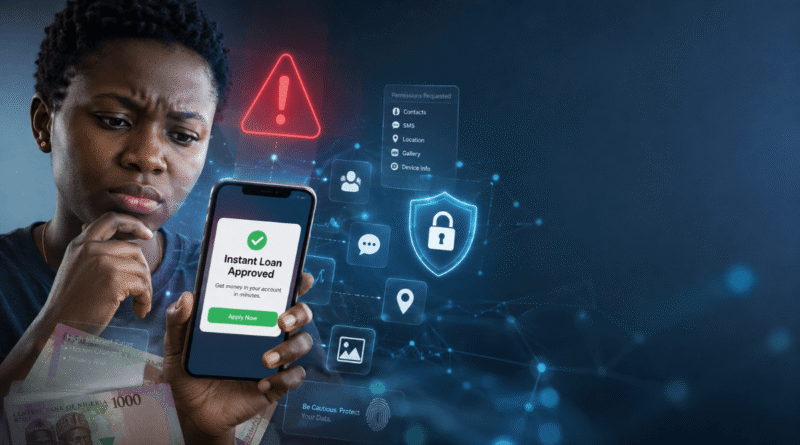
You download the app, fill in your details, upload your ID card and grant every permission it requests because you’re eager to receive the money quickly.
Instead of receiving the promised loan, something unexpected happens.
The app begins requesting additional fees.
Customer support stops responding.
Then threatening messages start arriving.
Soon afterwards, your friends, relatives or colleagues begin receiving messages accusing you of refusing to repay a loan.
Although this scenario is fictional, it reflects a pattern reported by many victims of deceptive digital lending schemes.
In recent years, digital lending has transformed the way Nigerians access credit. Today, legitimate mobile lending platforms enable individuals and businesses to apply for loans without visiting a bank branch, making financial services more convenient and accessible.
Unfortunately, the same technology that has expanded financial inclusion has also created opportunities for fraudsters.
Fake loan apps in Nigeria exploit people’s financial difficulties, limited digital awareness and desire for quick solutions. Some are designed to collect illegal upfront payments, while others harvest personal information or use intimidation to pressure borrowers into making repayments under unfair conditions.
The consequences often extend beyond financial loss.
Victims may suffer identity theft, privacy violations, reputational damage, emotional distress and long-term exposure to future scams after sensitive information falls into the wrong hands.
The encouraging news is that most fake loan app scams share common warning signs.
Once you understand how these fraudulent lending platforms operate, you will be far less likely to become their next victim.
In this comprehensive guide, you’ll discover:
- what fake loan apps are and how they work;
- why they continue to target Nigerians;
- how to identify warning signs before downloading an app;
- practical ways to verify whether a lender appears trustworthy;
- what to do if you’ve already shared information with a suspicious loan app; and
- simple habits that can help you borrow more safely in the digital age.
Whether you’re considering an online loan for the first time or simply want to improve your digital safety, the knowledge in this guide could save you from financial loss and unnecessary stress.
Who Should Read This Guide?
This article is written for anyone who uses—or may one day need to use—digital financial services.
It will be especially helpful if you are:
- a student looking for emergency funds;
- a salary earner facing unexpected expenses;
- a trader or small business owner seeking working capital;
- a first-time borrower exploring online lending;
- a parent managing school fees or household bills;
- a job seeker navigating financial uncertainty; or
- someone who simply wants to stay informed about online scams.
Even if you never intend to borrow money through a mobile app, understanding how these scams work can help you protect yourself and warn those around you.
Quick Takeaway
The fastest loan is not always the safest loan.
Spending just five minutes verifying a lender before applying could save you from losing your money, exposing your personal information or becoming the victim of identity theft.
Table of Contents
What Are Fake Loan Apps in Nigeria?
Fake loan apps are mobile applications or online lending platforms that present themselves as legitimate lenders but operate in deceptive, unethical or fraudulent ways.
Unlike responsible digital lenders that provide clear information about interest rates, repayment schedules and privacy practices, deceptive loan applications often rely on misleading promises to persuade people to share sensitive information or pay unnecessary charges.
At first glance, these apps can appear genuine.
Many have professionally designed logos, attractive websites, polished advertisements and convincing customer reviews.
Some even imitate the names or visual identity of legitimate financial companies to appear more trustworthy.
The danger usually becomes apparent only after users begin interacting with the app.
Depending on the scam, fraudulent lending platforms may:
- request unnecessary access to your phone;
- collect excessive personal information;
- demand illegal processing or activation fees;
- hide unfair charges;
- intimidate borrowers during debt recovery; or
- misuse personal information for other fraudulent activities.
Their objective is rarely to build a long-term relationship with customers.
Instead, many exist primarily to exploit trust, urgency and financial vulnerability.
Digital Lending Is Not the Problem
It is important to make one distinction clear.
Digital lending itself is not the problem.
Across Nigeria, many legitimate financial technology companies have helped improve access to credit, particularly for individuals and small businesses that may find it difficult to obtain traditional bank loans.
The problem arises when dishonest operators imitate legitimate lenders or adopt unethical practices that exploit borrowers.
Understanding this difference helps consumers make informed borrowing decisions rather than avoiding digital financial services altogether.
Understanding Nigeria’s Consumer Protection Environment
Nigeria has regulatory and legal frameworks that relate to consumer protection, privacy, and digital financial services. While the specific obligations that apply to a lender depend on its business model and regulatory status, borrowers should still expect certain basic standards before sharing personal information or accepting a loan.
As a general rule, a lender should be able to provide:
- clear information about its identity and contact details;
- transparent loan terms, fees and repayment conditions;
- an accessible customer support channel;
- a privacy policy explaining how personal information is collected and used; and
- fair treatment throughout the borrowing process.
If a lender is unwilling to explain who they are, how the loan works or how your information will be handled, that should be treated as a warning sign rather than an inconvenience.
Transparency builds trust.
Secrecy creates risk.
Mini Case Study
Consider two different loan applications.
The first explains its interest rates, repayment schedule, customer support channels and privacy policy before asking for your information.
The second simply promises:
“Guaranteed Approval.”
“Money in Five Minutes.”
“Limited-Time Offer.”
No explanation.
No business address.
No meaningful customer support.
Which one deserves your trust?
Responsible financial services earn confidence through transparency—not urgency.
Why This Matters
Many victims later admit they ignored small warning signs because they urgently needed money.
Scammers understand this.
They know that financial stress often causes people to focus on getting the loan rather than evaluating the lender.
Learning to slow down for a few minutes before downloading an app may be one of the simplest financial decisions you ever make.
Can Fake Loan Apps Steal Your Identity?
The short answer is yes—they can, depending on the information you provide and the permissions you grant.
Identity theft occurs when criminals obtain enough personal information to impersonate another person for financial gain, fraud, or other illegal activities. While not every suspicious loan app engages in identity theft, fraudulent operators often collect far more information than is reasonably required to assess a loan application.
A typical loan application may ask for your:
- Full name
- Phone number
- Email address
- Residential address
- National Identification Number (NIN) or other identity documents
- Bank account details
- Bank Verification Number (BVN), where legitimately required
- Selfie or facial verification image
Providing this information to an untrustworthy platform can expose you to risks that extend well beyond the loan itself.
For example, stolen personal information may be used to:
- impersonate you during future scams;
- target you with phishing or social engineering attacks;
- attempt unauthorised access to financial accounts; or
- combine your information with data leaked elsewhere to increase the effectiveness of fraud.
The important point is this:
You may lose far more than money. You may lose control over your personal identity.
That is why protecting your personal information is one of the simplest and most effective ways to reduce your risk of identity theft, financial fraud, and future online scams.
Why Do Fake Loan Apps Request So Many Permissions?
Many users instinctively tap “Allow” whenever a mobile app requests permission to access their phone.
Unfortunately, scammers know this.
Some deceptive loan applications ask for permissions that go far beyond what is reasonably necessary to process a loan application.
While legitimate lenders may request limited information for identity verification or account security, unnecessary access to your device should always prompt further questions.
Before granting any permission, ask yourself:
“Does this app genuinely need this information to assess my loan application?”
If the answer is unclear, proceed with caution.
Understanding Common Phone Permissions
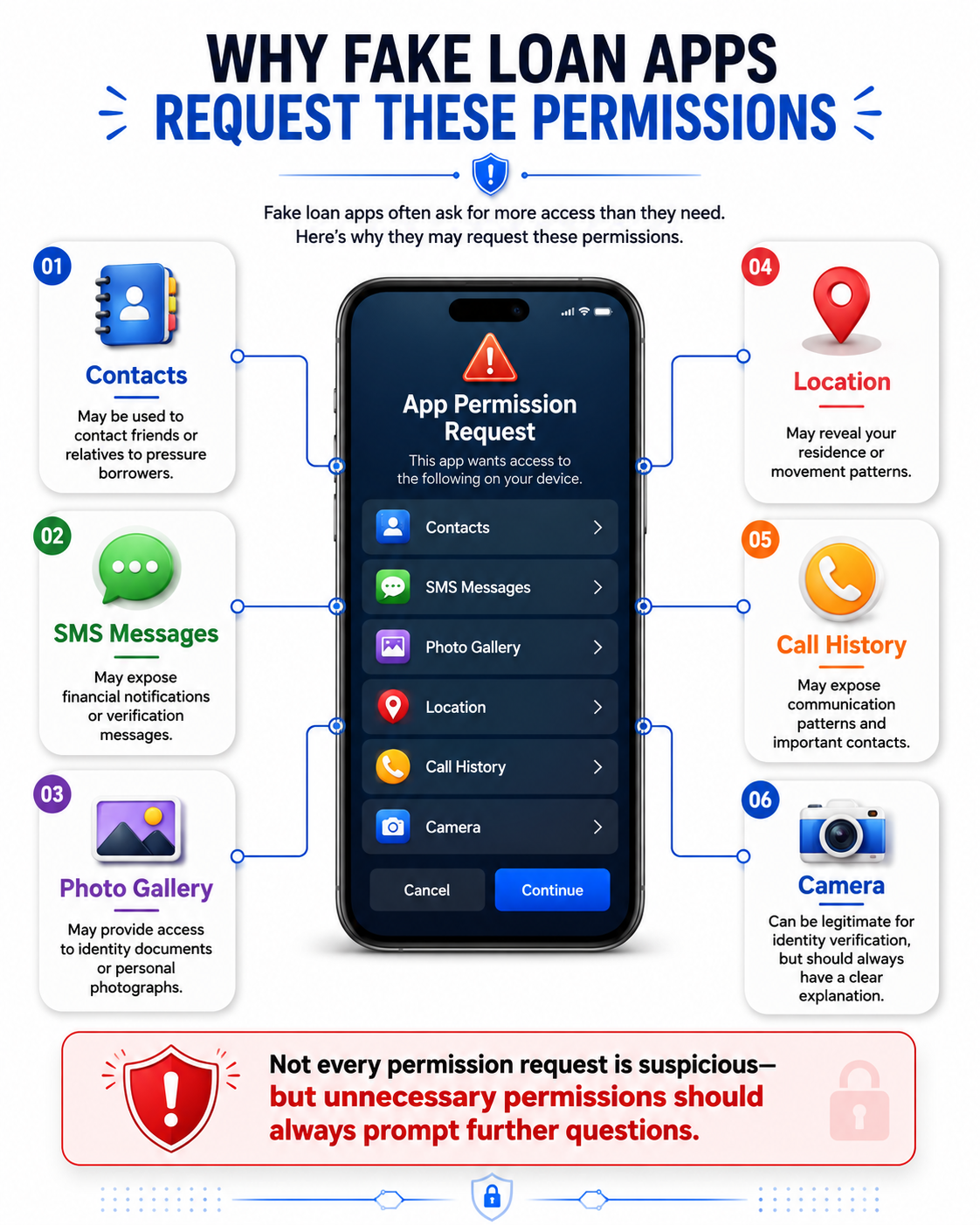
The table below explains why certain permissions should attract your attention.
| Permission Requested | Why a Fraudulent App May Want It |
|---|---|
| Contacts | To contact friends, relatives, colleagues, or employers in an attempt to pressure or embarrass borrowers. |
| SMS Messages | To view financial notifications, one-time verification codes, or personal communications that could support future scams. |
| Photo Gallery | To obtain identity documents, passport photographs, or personal images that could be misused. |
| Location | To build a profile of your movements, residence, or frequently visited places. |
| Call Logs | To understand your communication patterns or identify people close to you. |
| Microphone | Unless clearly justified, microphone access is rarely necessary for processing a standard loan application. |
| Camera | May be used for identity verification by legitimate lenders, but should always be accompanied by a clear explanation. |
The presence of these permissions does not automatically mean an app is fraudulent.
However, when several unnecessary permissions are combined with unrealistic promises or poor transparency, they should be treated as important warning signs.
Expert Insight
From a cybersecurity perspective, personal information is often more valuable to fraudsters than a one-time payment.
Unlike stolen cash, personal data can be reused repeatedly. Criminals may combine information collected from fake loan applications with data obtained through phishing attacks, social engineering, or previous data breaches to target victims again in the future.
This is why cybersecurity professionals consistently encourage people to share only the minimum amount of personal information required—and only with organisations they have taken reasonable steps to verify.
Scam Anatomy: How a Fake Loan App Scam Typically Unfolds
Although individual scams vary, many follow a remarkably similar pattern.
Attractive Advertisement
            │
            ▼
Download the App
            │
            ▼
Grant Phone Permissions
            │
            ▼
Submit Personal Information
            │
            ▼
Promise of Instant Approval
            │
            ▼
Hidden Charges or Small Loan
            │
            ▼
Harassment, Privacy Violations,
Identity Theft or Financial Loss
Understanding this sequence helps you recognise suspicious behaviour before the situation escalates.
One of the most effective ways to avoid becoming a victim is to interrupt the process before sharing unnecessary information.
Myth vs Fact
Myth:
“If I don’t accept the loan, nothing bad can happen.”
Fact:
In some cases, simply downloading an app and granting unnecessary permissions may expose your personal information.
If an application has already accessed your contacts, photographs, or messages, uninstalling it later may not completely undo the information that has already been collected.
That is why it is safer to evaluate an app before installing it than to deal with the consequences afterwards.
Why Intelligent People Still Fall for Fake Loan Scams
One of the biggest misconceptions about financial scams is that only careless or inexperienced people become victims.
The reality is very different.
Fraudsters deliberately exploit normal human emotions and decision-making under pressure.
Behavioural research has shown that urgency, fear, and emotional stress can reduce the amount of time people spend evaluating risks. Criminals understand this well and design their scams accordingly.
They commonly rely on five psychological triggers:
1. Urgency
“Apply now.”
“Offer expires today.”
“Only a few approvals remaining.”
These messages encourage quick decisions before careful verification.
2. Hope
When people urgently need money for rent, school fees, healthcare, or business expenses, promises of instant approval become especially persuasive.
3. Authority
Professional logos, polished websites, customer testimonials, and official-sounding language can create the impression that an organisation is legitimate—even when it is not.
4. Scarcity
Fraudsters often suggest that opportunities are limited:
“Only available today.”
“Limited slots.”
Artificial scarcity pressures people to act quickly.
5. Fear
Some deceptive lenders immediately threaten legal action, public embarrassment, or contact with family members if borrowers hesitate or question suspicious requests.
Fear is used to discourage victims from seeking advice or reporting the incident.
Did You Know?
Studies of online fraud consistently show that scammers are most successful when victims feel rushed or emotionally pressured.
Taking even five to ten minutes to verify a lender’s identity, read independent reviews, and examine the app’s permissions can significantly improve your ability to spot suspicious behaviour.
Red Flags at a Glance
Pause and investigate further if a loan app:
- Guarantees loan approval regardless of your circumstances.
- Requests payment before releasing a loan.
- Asks for permissions unrelated to lending.
- Pressures you to apply immediately.
- Provides little or no information about the company behind the app.
- Makes unrealistic promises without explaining the loan terms.
- Avoids answering basic customer service questions.
One warning sign may not prove a lender is fraudulent.
Several warning signs appearing together should encourage extra caution.
The 10 Warning Signs Every Nigerian Borrower Should Know
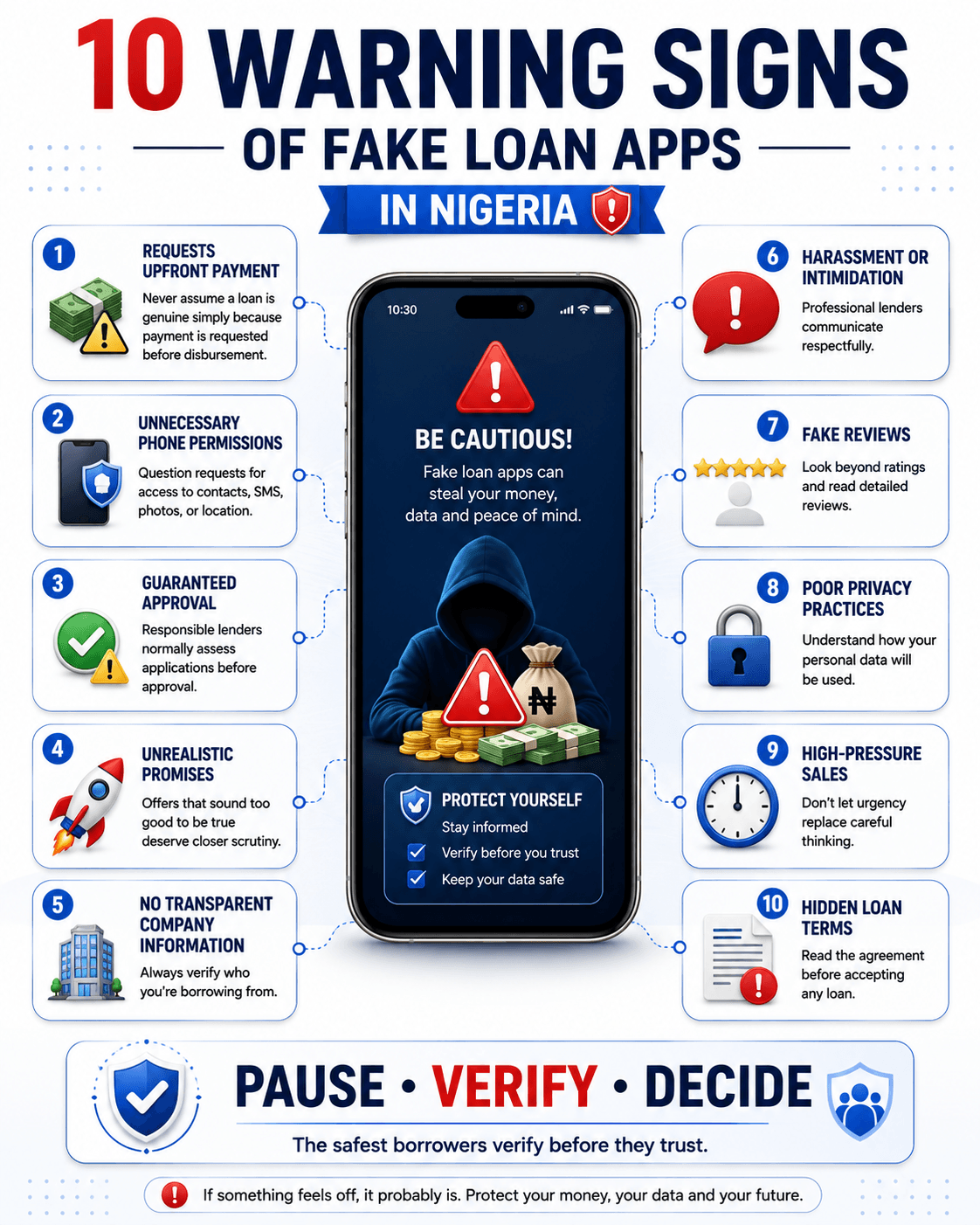
By now, you understand how deceptive loan applications operate and why they continue to target people facing financial pressure.
The next question is:
How can you recognise a suspicious loan app before it causes harm?
Fortunately, many fraudulent lending platforms leave behind warning signs long before they demand money or misuse your personal information. The challenge is knowing what those warning signs look like—and taking them seriously.
No single red flag automatically proves that a lender is fraudulent. However, when several warning signs appear together, they should encourage you to pause, verify the lender’s credibility, and think carefully before sharing your personal information.
The following warning signs are among the most common indicators of deceptive or unethical lending practices.
1: The Lender Requests Payment Before Releasing Your Loan
Imagine applying for a ₦200,000 loan.
A few minutes later, you’re told your application has been approved—but before the money can be released, you must first pay:
- a processing fee,
- an activation fee,
- insurance,
- documentation charges, or
- a verification fee.
The lender assures you that the payment is “refundable” or will be deducted later.
It sounds reasonable.
It isn’t.
One of the oldest financial scams is asking victims to pay money in order to receive money.
Once the payment is made, several things may happen:
- communication suddenly stops;
- new charges appear;
- customer service becomes unreachable; or
- the promised loan never arrives.
Even worse, some victims continue paying additional “fees” because they believe the loan is almost ready.
This is known as the sunk cost trap—the tendency to keep investing because you’ve already invested something.
Fraudsters understand this psychology remarkably well.
Why This Should Raise Concern
Legitimate lenders explain their fees clearly and should not rely on surprise payments to release approved funds.
If any charges apply, they should be disclosed transparently so borrowers understand the total cost of the loan before making a decision.
Unexpected payment requests deserve careful scrutiny.
Mini Scenario
Ada urgently needs ₦80,000 for hospital expenses.
After applying online, she’s informed that she must first pay ₦7,500 for “account activation.”
She pays.
A second message requests another ₦12,000 for “insurance.”
No loan is ever disbursed.
The activation fee was never about processing the loan—it was the scam.
What You Should Do Instead
Before paying any fee:
- Ask why the payment is required.
- Read the lender’s loan terms carefully.
- Verify whether the company provides clear contact information.
- Research independent reviews from multiple sources.
- If the explanation is vague or keeps changing, walk away.
Quick Takeaway
Never let urgency override caution.
If a lender unexpectedly asks you to pay money before you receive a loan, stop and verify the request before making any payment.
2: The App Requests Unnecessary Access to Your Phone
Not every permission request is suspicious.
For example, a lender may legitimately request access to your camera if identity verification requires taking a photograph of yourself or your identification document.
The concern arises when an app asks for information that appears unrelated to assessing your loan application.
For example:
- Why does a loan app need your entire contact list?
- Why does it need access to your photo gallery?
- Why should it read your SMS messages?
- Why would it require your microphone?
These are questions every borrower should ask before tapping “Allow.”
Understanding the Risk
Every permission you grant gives an app additional access to your personal information.
The more unnecessary access you approve, the greater the potential impact if that information is misused.
For example:
| Permission | Potential Risk |
|---|---|
| Contacts | Family members or colleagues may be contacted to pressure or embarrass you. |
| SMS | Financial notifications or verification messages could be exposed. |
| Photo Gallery | Identity documents or personal photographs may be copied. |
| Location | Information about your residence or daily movements may be collected. |
| Call History | Close contacts and communication patterns may become visible. |
A legitimate reason should accompany every permission request.
If it doesn’t, treat it as a warning sign.
Expert Insight
From a cybersecurity perspective, data minimisation is one of the most effective ways to reduce risk.
In simple terms, organisations should collect only the information genuinely needed to provide their services.
Whenever an app requests more information than seems necessary, it is reasonable to ask why.
Responsible organisations should be able to provide a clear explanation.
Mini Scenario
James installs a loan app after seeing an advert promising instant approval.
Without reading the permission requests, he grants access to his contacts, messages, location, and gallery.
Weeks later, after disputing repayment charges, several friends receive messages claiming he has defaulted on a loan.
The financial loss was only part of the problem.
His privacy had already been compromised.
What You Should Do Instead
Before granting permissions:
- Read every permission request carefully.
- Deny access that appears unrelated to lending.
- Check whether the app explains why the permission is needed.
- Review the privacy policy.
- If you’re uncomfortable with the level of access requested, consider another lender.
Expert Tip
Your personal information is often more valuable than your money.
Once sensitive data has been copied, deleting the app may not undo the exposure.
3: “Guaranteed Approval” Regardless of Your Circumstances
One advertisement says:
“Everyone gets approved.”
Another promises:
“100% guaranteed loan.”
A third claims:
“No checks. No questions. Instant money.”
These advertisements are designed to remove doubt.
After all, who wouldn’t prefer guaranteed approval?
The problem is that responsible lending involves assessing whether a borrower can reasonably repay a loan.
No lender can honestly promise approval for every applicant regardless of their financial circumstances.
Why This Is a Red Flag
Every loan involves risk.
Responsible lenders usually consider factors such as:
- identity verification;
- application information;
- repayment ability;
- fraud prevention measures; and
- other eligibility requirements.
While the assessment process may be quick, it should still exist.
Advertisements suggesting that absolutely everyone qualifies deserve careful scrutiny.
Why Scammers Make This Promise
“Guaranteed approval” removes one of the biggest fears borrowers have:
being rejected.
By eliminating uncertainty, scammers encourage people to act quickly without asking important questions about fees, privacy, or loan terms.
It shifts attention away from verification and towards immediate gratification.
Myth vs Fact
Myth
“If everyone qualifies, the company must be helping people.”
Fact
Promises that sound too good to be true often deserve additional verification.
Responsible lenders generally explain how eligibility is assessed rather than promising approval under every circumstance.
Questions You Should Ask
Before applying, consider:
- Does the lender explain how applications are assessed?
- Are eligibility requirements described clearly?
- Does the company explain repayment obligations?
- Are the loan terms easy to understand?
Transparency is usually a better indicator of trustworthiness than bold marketing promises.
Key Takeaway
Responsible lenders earn trust through transparency—not unrealistic guarantees.
When an advertisement promises approval without meaningful assessment, take a step back and investigate before sharing your information.
4: Unrealistic Interest Rates or Promises That Sound Too Good to Be True
Imagine seeing an advert that says:
“Borrow ₦500,000 today.”
“0% interest.”
“No repayment worries.”
“No conditions attached.”
For someone under financial pressure, these offers can be extremely appealing.
However, they should also raise an important question:
How can a lender remain in business if it never charges realistic fees or explains how the loan works?
Responsible lending involves costs. Legitimate lenders usually disclose interest rates, repayment schedules, administrative charges (where applicable), and the consequences of late repayment before you accept a loan.
Fraudulent lenders often avoid these details. Instead, they rely on attractive marketing messages that encourage borrowers to focus only on receiving money quickly.
Why This Is a Warning Sign
Offers that appear unusually generous often deserve additional scrutiny.
Watch out for advertisements that promise:
- Extremely large loans with little or no explanation.
- Interest-free loans without clearly stated conditions.
- Instant approval combined with unrealistic repayment terms.
- “Unlimited” borrowing.
- Lifetime low-interest offers with no supporting details.
The issue isn’t simply the promise—it’s the lack of transparency behind it.
Why Scammers Use These Offers
Fraudsters understand that attractive promises reduce scepticism.
When people focus on the excitement of receiving money quickly, they are less likely to:
- read the loan agreement;
- question hidden fees;
- review app permissions; or
- research the lender.
The promise becomes a distraction.
Mini Scenario
Bola sees an advert offering a ₦300,000 loan with “0% interest forever.”
Excited by the offer, he downloads the app without reading the terms.
Only after completing the application does he discover multiple charges described as “processing,” “maintenance,” and “administrative” fees.
Although the interest appears low, the overall cost of borrowing is much higher than expected.
Pro Tip
Instead of asking,
“How much can I borrow?”
Ask,
“What will this loan actually cost me?”
Understanding the total cost of borrowing is more important than the advertised loan amount.
Quick Takeaway
A trustworthy lender explains the cost of borrowing before you commit—not after you’ve submitted your information.
5: The Company Is Difficult to Verify
Every legitimate business should be willing to tell customers who they are.
Unfortunately, some deceptive loan apps provide little information about the organisation behind the service.
You may notice:
- no physical address;
- no verifiable customer support;
- no company history;
- no official website; or
- vague contact information.
Instead, the app may rely entirely on social media adverts or messaging platforms.
That lack of transparency should prompt additional questions.
Why Transparency Matters
Borrowing money creates a financial relationship.
Before entering that relationship, you should know:
- Who is providing the loan?
- How can they be contacted?
- Where are they located?
- How are complaints handled?
- What happens if something goes wrong?
Businesses that hide this information make it difficult for consumers to seek clarification or resolve disputes.
Practical Verification Checklist
Before applying for a loan, look for:
✓ A clearly identified company name.
✓ Transparent contact information.
✓ An official website.
✓ Accessible customer support.
✓ Clearly written loan terms.
✓ A privacy policy explaining how your information is handled.
The more transparent a lender is, the easier it becomes to evaluate whether you are comfortable doing business with them.
Mini Scenario
Two loan apps advertise similar products.
The first provides:
- an official website;
- detailed loan terms;
- customer support channels; and
- answers to frequently asked questions.
The second only provides a phone number and promises “instant approval.”
Which company appears more accountable?
Transparency doesn’t automatically prove legitimacy, but a lack of transparency should always encourage additional caution.
Why This Matters
Scammers often depend on anonymity.
The less information they provide about themselves, the harder it becomes for victims to ask questions, seek support, or report suspicious behaviour.
6: Harassment, Intimidation, or Public Shaming
Borrowing money does not mean giving up your right to be treated with dignity and respect.
While borrowers have a responsibility to repay legitimate loans according to agreed terms, debt recovery should still be conducted professionally and ethically.
Unfortunately, some deceptive loan applications rely on intimidation rather than communication.
Borrowers have reported experiences such as:
- repeated threatening phone calls;
- abusive messages;
- contacting relatives, colleagues, or employers;
- public accusations of fraud or debt default; and
- attempts to embarrass borrowers into making immediate payments.
These tactics are designed to create fear rather than resolve disagreements.
Why Scammers Use Harassment
Fear is a powerful motivator.
People worried about embarrassment or damage to their reputation may make rushed financial decisions simply to stop the pressure.
This emotional response is exactly what unethical operators hope to create.
How Responsible Lenders Differ
Responsible lenders generally:
- explain repayment expectations clearly;
- communicate professionally;
- provide opportunities to discuss repayment difficulties; and
- treat customers respectfully, even when payments are overdue.
Professional communication builds trust.
Harassment destroys it.
Mini Scenario
After missing a repayment deadline because of an unexpected medical emergency, Ibrahim receives several calls from a lender.
One representative calmly explains the repayment options.
Another lender might instead threaten to contact his employer immediately.
The difference is not simply customer service.
It reflects the organisation’s attitude toward borrowers.
Myth vs Fact
Myth
“If a lender is aggressive, they must be serious and therefore legitimate.”
Fact
Professional organisations do not need intimidation to enforce legitimate agreements.
Harassment should never be accepted as evidence that a lender is trustworthy.
Key Takeaway
Respect is a hallmark of responsible lending.
If a lender relies on threats, humiliation, or intimidation instead of professional communication, reconsider whether you want to continue dealing with them.
7: Reviews That Look Too Perfect—or Too Similar
Before downloading an app, many people check online reviews.
That’s a sensible habit.
However, reviews themselves can sometimes be misleading.
Some dishonest operators attempt to create a false impression of popularity by using repetitive or overly enthusiastic reviews that provide little useful information.
For example:
⭐⭐⭐⭐⭐
“Best loan app ever!”
or
⭐⭐⭐⭐⭐
“Very fast.”
Hundreds of nearly identical comments should encourage closer examination rather than immediate trust.
How to Read Reviews More Critically
Instead of looking only at the overall star rating, pay attention to:
- whether reviews describe real experiences;
- balanced comments that mention both strengths and weaknesses;
- recent reviews rather than only older ones;
- recurring complaints about customer support, transparency, or repayments; and
- whether responses from the company appear professional.
No company satisfies every customer.
A mixture of positive and constructive feedback often appears more authentic than hundreds of identical five-star reviews.
Expert Tip
Independent reviews should support your decision—not make it for you.
Use them alongside other checks such as:
- reviewing the loan terms;
- examining requested permissions;
- verifying company information; and
- reading the privacy policy.
Good decisions are based on multiple sources of information, not a single rating.
Quick Takeaway
Don’t confuse popularity with credibility.
A high rating is useful only when it is supported by transparency, realistic customer experiences, and clear information about the lender.
You’ve now learned how to identify seven of the ten most common warning signs associated with deceptive or unethical lending platforms.
Take a moment to reflect:
Would you still install a loan app that:
- asks for unnecessary permissions?
- hides important loan terms?
- promises guaranteed approval?
- has no verifiable company information?
- pressures you into making quick decisions?
If the answer is no, you’re already developing the habits that help protect people from many online financial scams.
8: Poor Privacy Practices and Weak Data Protection
When applying for a loan, you are often asked to share some of your most sensitive personal information. This may include your name, phone number, address, identity documents, banking details, and, depending on the lender’s verification process, additional personal information.
Before sharing that information, ask yourself one simple question:
“Does this company clearly explain how my personal information will be collected, used, stored, and protected?”
If the answer is no, proceed carefully.
Responsible organisations understand that trust begins with transparency. They explain why information is collected, how long it may be retained, whether it is shared with third parties, and what rights customers have regarding their data.
By contrast, deceptive lending platforms often provide little—or no—meaningful explanation.
Signs of Poor Privacy Practices
While no single issue proves that an app is fraudulent, you should pay closer attention if you notice:
- no privacy policy;
- a privacy policy that is vague or difficult to understand;
- excessive collection of personal information without explanation;
- unclear statements about who can access your information; or
- no explanation of how customer data is protected.
A trustworthy lender should not expect you to share sensitive information without first explaining how it will be handled.
Why This Matters
Once personal information has been copied or shared, it can be difficult—or impossible—to retrieve.
Unlike a password, you cannot simply replace your identity documents, contact history, or personal photographs overnight.
That is why protecting your privacy before applying is far easier than trying to repair the damage afterwards.
Mini Scenario
Ngozi downloads a loan app that requests copies of her identity documents and a selfie.
She notices there is no privacy policy and no explanation of how her information will be stored.
Although the loan offer appears attractive, she decides not to continue.
A few minutes spent asking questions may have saved her from a much larger problem later.
Quick Takeaway
Never treat your personal information as “just another form.”
Your data is valuable, and every responsible lender should explain how it will be protected.
9: High-Pressure Sales Tactics
One of the most effective tools used by scammers is urgency.
Instead of giving borrowers time to compare options or read the loan agreement, they encourage immediate decisions.
You may see messages such as:
- “Offer expires in 10 minutes.”
- “Limited approvals remaining.”
- “Apply now or lose your chance.”
- “Only available today.”
These messages are designed to trigger an emotional response.
The faster you act, the less time you have to verify the lender.
The Psychology Behind Urgency
Urgency narrows attention.
When people feel they are about to lose an opportunity, they often focus on the promised reward rather than the potential risks.
Behavioural psychologists sometimes describe this as fear of missing out (FOMO).
Fraudsters exploit this tendency by making borrowers feel that delaying their decision could cost them an important opportunity.
What Responsible Lenders Do
Responsible lenders understand that borrowing money is an important financial decision.
Rather than pressuring customers into immediate action, they usually provide:
- sufficient time to review the loan agreement;
- clear explanations of fees and repayment terms;
- customer support to answer questions; and
- opportunities to compare options before accepting the loan.
A lender that discourages careful reading or independent verification should raise concerns.
Mini Scenario
Emeka receives two loan offers.
The first says:
“Take your time. Review the loan terms before accepting.”
The second repeatedly displays countdown timers and messages urging him to apply immediately.
Which lender appears more interested in helping customers make informed decisions?
Pressure should never replace transparency.
Expert Tip
Whenever someone tells you not to think too much before making a financial decision, that is exactly when you should slow down.
10: Confusing, Hidden, or Incomplete Loan Terms
Imagine agreeing to borrow money without knowing:
- how much interest you will pay;
- when repayment is due;
- what happens if you miss a payment; or
- whether additional charges may apply.
Most people would never intentionally accept those risks.
Yet many borrowers skip the loan agreement because they are focused on receiving money quickly.
Fraudulent lending platforms often rely on this behaviour.
Important Questions Every Borrower Should Ask
Before accepting any loan, make sure you can clearly answer the following questions:
- How much money am I actually receiving?
- What is the total cost of borrowing?
- What is the repayment schedule?
- Are there additional fees?
- What happens if I repay early?
- What happens if I miss a payment?
- Who should I contact if I have questions?
If you cannot answer these questions after reading the loan agreement, you probably need more information before proceeding.
Why Hidden Terms Are Dangerous
Confusing loan agreements create uncertainty.
Borrowers who do not fully understand the repayment conditions may later discover:
- unexpected charges;
- shorter repayment periods than expected;
- additional administrative fees; or
- obligations they never realised they had accepted.
Financial decisions should never depend on guesswork.
Mini Scenario
Amina accepts a loan because the application highlights only the amount she will receive.
Several weeks later, she discovers additional charges buried within the agreement that significantly increase the total repayment amount.
The problem wasn’t that she borrowed money.
The problem was that she accepted terms she never fully understood.
Key Takeaway
If the loan terms are difficult to understand, don’t assume everything is fine.
Ask questions. Read carefully. If important information remains unclear, consider another lender.
Red Flags at a Glance
Before downloading or using any loan app, pause if you notice several of the following warning signs:
- Guaranteed approval regardless of your circumstances.
- Requests for payment before loan disbursement.
- Excessive requests for contacts, messages, or other unnecessary permissions.
- Unrealistic promises that sound too good to be true.
- No clear company information or customer support.
- Poor or missing privacy practices.
- Harassment or intimidation.
- Fake-looking reviews.
- High-pressure sales tactics.
- Hidden or confusing loan terms.
One warning sign may simply require additional investigation.
Several warning signs appearing together should encourage you to walk away.
How Many Warning Signs Are Too Many?
Many readers ask:
“How many red flags should I ignore before deciding not to use a loan app?”
The safest answer is:
Don’t count warning signs—evaluate them.
Some issues are relatively minor.
Others should immediately stop you from proceeding.
For example, demanding payment before releasing a loan or requesting unnecessary access to your contacts without a clear explanation are concerns that deserve serious attention.
Instead of asking,
“Can I still use this app?”
Ask,
“Have I seen enough transparency to trust this company with my money and personal information?”
If your answer is uncertain, it is usually safer to continue your search.
Remember:
Needing money urgently does not mean you must ignore warning signs.
Decision Checklist: Should You Continue?
Before submitting your application, ask yourself these five questions:
✅ Do I know who owns this lending company?
✅ Do I clearly understand the repayment terms?
✅ Does the app request only permissions that make sense?
✅ Have I independently researched the company?
✅ Do I feel informed rather than pressured?
If you answered “No” to several of these questions, consider pausing your application until you obtain more information.
Good financial decisions are rarely made in a hurry.
Key Takeaways
The most effective protection against fake loan apps is not fear—it is informed decision-making.
Before trusting any digital lender:
- verify who they are;
- understand what you’re agreeing to;
- protect your personal information;
- question unrealistic promises; and
- never let urgency replace careful thinking.
Scammers rely on emotional reactions.
Responsible lenders encourage informed decisions.
Knowing the difference is one of the most valuable financial skills you can develop.
How Fake Loan Apps Operate and How to Protect Yourself
By now, you’ve learned how to identify the most common warning signs of fraudulent lending platforms. But recognising a red flag is only the beginning.
The next step is understanding how these scams work behind the scenes.
This matters because deceptive loan apps constantly evolve. An app that disappears today may return tomorrow under a different name, logo, or developer. Fraudsters frequently change their branding to avoid detection, making it difficult for borrowers to rely solely on lists of “bad apps.”
The most effective defence isn’t memorising names—it’s understanding the patterns scammers use.
Once you recognise those patterns, you’ll be able to identify suspicious loan apps even if you’ve never encountered them before.
In this section, we’ll examine the most common tricks used by deceptive lending platforms, explain why they work, and show you practical ways to protect your money, your personal information, and your peace of mind.
Before You Download: Pause and Think
When money is urgently needed, it’s natural to focus on how quickly you can receive it.
Unfortunately, scammers rely on this urgency.
Before installing any loan app, pause for just a few minutes and ask yourself these questions:
- Who owns this company?
- Can I easily find its official website?
- Does the app clearly explain how my personal information will be used?
- Would I be comfortable giving this company my identity documents?
- Am I making this decision because I’ve carefully evaluated the lender—or simply because I urgently need money?
These questions may seem simple, but they encourage critical thinking instead of emotional decision-making.
Remember: Financial pressure should explain your urgency—not determine your judgement.
How Fake Loan Apps Gain Your Trust
One of the biggest misconceptions about loan app scams is that they begin with threats.
In reality, they usually begin with trust.
Fraudsters understand that very few people would knowingly download an app they believed was designed to scam them. Instead, they first create the appearance of legitimacy.
Only after gaining your confidence do they begin requesting more information, more permissions, or more money.
This gradual approach is one reason these scams continue to succeed.
Trick 1: Attractive Advertisements That Promise Quick Solutions
Many fraudulent loan apps invest heavily in professional-looking marketing campaigns.
You may encounter these adverts while browsing:
- TikTok
- WhatsApp Status
- Telegram channels
- Sponsored Google search results
- YouTube advertisements
The wording is carefully chosen to appeal to people facing financial pressure.
Examples include:
“Emergency cash in minutes.”
“Instant approval.”
“No collateral.”
“Borrow today, pay later.”
“Everyone qualifies.”
At first glance, these advertisements may look almost identical to those used by legitimate lenders.
That’s intentional.
Why This Trick Works
Fraudsters don’t sell loans first.
They sell hope.
Someone struggling to pay rent, cover medical expenses, finance education, or restock a business is naturally more likely to notice advertisements promising immediate financial relief.
Once emotions become involved, people are more likely to click first and investigate later.
Mini Case Study
Chioma owns a small clothing shop in Enugu.
After a slow month of sales, she needs additional capital before a busy holiday period.
While scrolling through Facebook, she sees an advert promising a ₦500,000 loan with “100% approval.”
Without researching the company, she downloads the app.
The advertisement wasn’t the scam.
It was the doorway to the scam.
How to Stay Safe
Whenever you see a loan advertisement:
✓ Resist the urge to download immediately.
✓ Visit the lender’s official website first.
✓ Compare several lenders instead of choosing the first one you see.
✓ Ask yourself whether the advertisement explains how the loan works—or simply encourages immediate action.
Trick 2: Creating a False Sense of Credibility
Most scammers understand that trust must be earned—or at least appear to be earned.
That’s why many deceptive loan apps invest time in looking professional.
They may use:
- modern mobile app designs;
- polished logos;
- impressive-looking websites;
- glowing customer testimonials;
- countdown timers;
- phrases such as “trusted by thousands.”
Some even imitate the names, colours, or branding of established financial companies to create confusion.
Why This Trick Works: The Power of Social Proof
Humans naturally look to others when making uncertain decisions.
Psychologists refer to this as social proof.
If an app appears popular, has thousands of positive reviews, or claims to have millions of satisfied users, people often assume it must be trustworthy.
Scammers exploit this instinct.
Professional design, however, is not proof of legitimacy.
Today’s design tools allow almost anyone to create convincing websites and mobile applications at relatively low cost.
Did You Know?
Some fraudulent operators invest more effort in designing attractive advertisements than in building an actual lending business.
Always verify the company behind the design, not just the design itself.
Can Fake Loan Apps Appear in Official App Stores?
Many people believe:
“If it’s available in an official app store, it must be safe.”
Unfortunately, that’s a misconception.
App stores review applications before publication, but no review process is perfect.
Occasionally, deceptive or policy-violating apps may appear on official marketplaces before they are identified and removed.
For that reason, downloading an app from an official app store should be viewed as one positive indicator—not proof that the app is trustworthy.
You should still:
- research the company;
- read independent reviews;
- understand the loan terms;
- examine the requested permissions; and
- evaluate whether the lender appears transparent.
App store availability is helpful—but it should never replace independent verification.
Trick 3: Requesting More Information Than Necessary
Every loan application requires some personal information.
That’s perfectly normal.
The warning sign appears when an app requests information that seems unrelated to providing a loan.
Examples include:
- unrestricted access to your contact list;
- continuous location tracking;
- unrestricted photo gallery access;
- call history;
- SMS messages;
- microphone permissions without explanation.
Why This Trick Works
Many users automatically tap “Allow” because they assume every permission is necessary.
Fraudsters take advantage of that assumption.
Every unnecessary permission provides additional information that may later be used for intimidation, identity theft, social engineering, or other fraudulent activities.
Think Before You Tap “Allow”
Instead of asking,
“Should I approve this permission?”
Ask,
“Why does this lender genuinely need this information to process my loan?”
If the explanation isn’t clear—or if no explanation is provided—you should think carefully before proceeding.
Responsible organisations generally explain why sensitive information is needed.
Expert Insight
From a cybersecurity perspective, many successful scams rely on layered persuasion rather than sophisticated hacking.
Fraudsters typically follow three stages:
- Gain your trust.
- Collect your information.
- Exploit that information.
Understanding this sequence makes it much easier to recognise suspicious behaviour before financial loss occurs.
Verification Flow: A Smarter Way to Evaluate Any Loan App
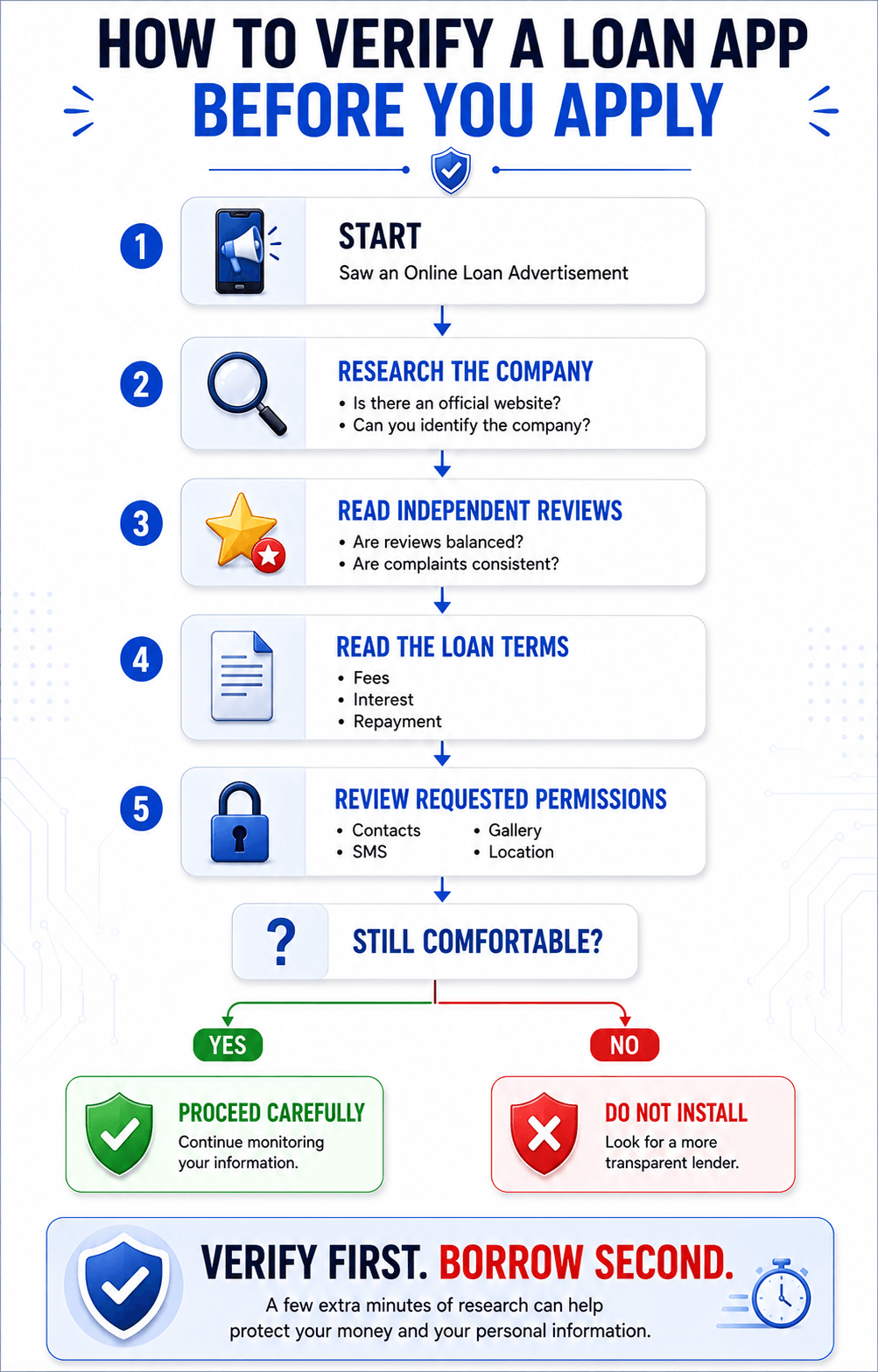
Instead of downloading the first app you see, use this simple decision-making process.
See a Loan Advertisement
          │
          ▼
Research the Company
          │
          ▼
Read Independent Reviews
          │
          ▼
Review Loan Terms
          │
          ▼
Check Requested Permissions
          │
          ▼
Still Comfortable?
      ┌─────────────┐
      │             │
     Yes            No
      │             │
      ▼             ▼
Proceed Carefully   Walk Away
Taking a few extra minutes to follow this process may help you avoid weeks—or even months—of financial stress.
Quick Takeaways
- Scammers often build trust before attempting fraud.
- Professional branding should never replace independent verification.
- Official app store listings are not guarantees of legitimacy.
- Always ask why an app needs access to your personal information.
- The safest borrowers are not those who never borrow—they are those who verify before they trust.
Becoming a Smarter Borrower
By this stage, you’ve learned how deceptive lending platforms attract attention, build trust, and persuade people to share personal information.
The next step is learning how to evaluate lenders critically before making any financial commitment.
Think of this section as your digital borrowing toolkit—a practical guide you can use every time you’re considering an online loan.
Trick 4: The “Small Loan” Strategy
One of the biggest misconceptions about fraudulent lending platforms is that they never release money.
In reality, some scammers deliberately approve and disburse small loans.
Why?
Because receiving money creates confidence.
Borrowers often think:
“If the loan arrived, the company must be legitimate.”
That assumption can make them less cautious during future interactions.
Only later do they discover hidden charges, confusing repayment conditions, privacy concerns, or aggressive collection tactics.
The initial loan becomes a tool for building trust—not proof of responsible lending.
Why This Strategy Works
Trust is easier to gain after delivering on a small promise.
Once borrowers believe the lender is genuine, they may be more willing to:
- borrow larger amounts;
- recommend the app to friends;
- overlook unusual behaviour;
- ignore warning signs.
Scammers understand this psychology.
Mini Case Study
Tunde borrows ₦25,000 to repair his motorcycle.
The money arrives within minutes.
Satisfied with the experience, he recommends the app to several friends.
A month later, after disputing unexpected charges, he begins receiving threatening messages, and some of his contacts are informed that he has refused to repay a loan.
The first loan established trust.
The later behaviour revealed the real problem.
Key Lesson
Receiving a loan should never be the only reason you trust a lender.
Evaluate the entire borrowing experience, including transparency, customer support, privacy practices, and communication.
Trick 5: Using Fear Instead of Communication
Scammers know that fear can influence decisions just as strongly as hope.
Some deceptive lenders rely on intimidation rather than respectful communication.
Borrowers have reported experiences such as:
- repeated threatening calls;
- abusive text messages;
- pressure to make immediate payments;
- attempts to embarrass borrowers by contacting people they know.
These tactics are designed to create panic.
Fear makes people less likely to pause, ask questions, or seek independent advice.
Why This Trick Works
When people feel embarrassed or threatened, they often focus on ending the pressure as quickly as possible.
Scammers exploit this emotional response.
Professional organisations, however, understand that disagreements and repayment difficulties can occur.
They should communicate respectfully and provide appropriate channels for resolving issues.
Expert Insight
From a behavioural psychology perspective, scammers often follow the same emotional sequence:
Hope → Urgency → Trust → Fear
Once you recognise this pattern, it becomes much easier to interrupt the scam before significant harm occurs.
How to Research a Loan App Like a Smart Consumer
One of the most valuable habits you can develop is learning how to verify information independently.
Rather than relying on advertisements or app store descriptions, spend a few minutes researching the lender yourself.
Step 1: Search Beyond the Advertisement
Instead of searching only for the company name, try combinations such as:
- [Company Name] review
- [Company Name] complaints
- [Company Name] Nigeria
- [Company Name] customer service
- [Company Name] scam (recognising that not every online allegation is accurate)
Look for patterns rather than isolated opinions.
Step 2: Visit the Official Website
Ask yourself:
- Is the website professionally maintained?
- Does it clearly explain the loan process?
- Can you easily find contact information?
- Are the loan terms understandable?
- Is there a privacy policy?
Transparency is generally a positive sign.
Step 3: Compare Multiple Sources
Don’t rely on a single review or one social media post.
Instead, compare information from:
- independent review platforms;
- consumer discussions;
- reputable news sources;
- the lender’s official communications.
Consistent information is usually more reliable than isolated comments.
Common Mistakes Borrowers Make
Many scams succeed because people make understandable—but avoidable—mistakes.
Here are some of the most common ones.
1. Choosing Speed Over Research
Urgency should never replace verification.
2. Granting Permissions Without Reading Them
Every permission deserves a reason.
3. Trusting Advertisements More Than Evidence
Professional marketing does not guarantee professional conduct.
4. Ignoring the Loan Agreement
Always understand what you’re agreeing to before accepting a loan.
5. Assuming Someone Else Has Already Verified the App
Many people believe:
“If thousands of others downloaded it, someone must have checked.”
Responsible borrowing means doing your own research.
Pause Before You Apply
Before submitting your application, take one minute and ask yourself:
- Am I rushing because I urgently need money?
- Have I compared this lender with others?
- Do I understand the repayment terms?
- Am I comfortable sharing this information?
- Would I recommend this lender to a close family member based on what I know today?
If any answer gives you pause, continue researching before proceeding.
The 5-Point Loan App Trust Score
To make your decision easier, use this simple scoring system.
| Question | Score |
|---|---|
| The company clearly identifies itself and provides verifiable contact information. | +1 |
| Loan terms are transparent and easy to understand. | +1 |
| Privacy practices are clearly explained. | +1 |
| Requested app permissions appear reasonable and relevant. | +1 |
| Independent reviews generally support the lender’s credibility. | +1 |
How to Interpret Your Score
| Score | What It Means |
|---|---|
| 5/5 | Strong transparency. Continue your assessment carefully before borrowing. |
| 4/5 | Generally encouraging, but investigate any missing area. |
| 3/5 | Proceed cautiously and gather more information before applying. |
| 2/5 or below | Significant concerns. Consider looking for an alternative lender. |
Important: This score is a practical decision-making tool—not a guarantee that a lender is safe or unsafe. Always consider the full picture before making financial decisions.
Quick Decision Framework
Whenever you’re unsure about a loan app, remember these three questions:
Can I verify this company?
Do I understand what I’m agreeing to?
Do I feel informed—or pressured?
If you cannot confidently answer all three, it’s worth slowing down and investigating further.
Key Takeaways
By now, you should be able to recognise that responsible borrowing is about more than finding the fastest loan.
It’s about making informed decisions.
Remember these principles:
- Verify before you trust.
- Read before you accept.
- Question unrealistic promises.
- Protect your personal information.
- Never let urgency replace careful thinking.
The safest borrowers aren’t necessarily the most experienced—they’re the ones who ask questions before sharing their money or personal information.
Related Reading
Fake loan apps are only one of many online scams targeting Nigerians. To strengthen your digital safety skills, we recommend reading our guides on Internet Safety in Nigeria and common WhatsApp scams in Nigeria, where you’ll learn practical strategies for protecting your personal information, recognising suspicious online activity, and staying safer while using digital services.
Recognising fake loan apps is only one part of becoming a responsible internet user. Our guide to Digital Citizenship in Nigeria explains how everyday online behaviour helps reduce scams and misinformation.
What to Do If You’ve Already Downloaded a Suspicious Loan App
Discovering that you may have downloaded a deceptive loan app can be worrying.
Perhaps you’ve already:
- installed the app;
- uploaded identity documents;
- granted access to your contacts or photo gallery;
- paid a processing fee; or
- even received a loan before becoming suspicious.
Your first reaction may be panic.
That’s understandable.
However, acting calmly and methodically is one of the best ways to reduce the impact of a suspicious loan app and protect both your finances and your personal information.
Remember:
Downloading a suspicious app does not automatically mean your identity has been stolen or your bank account has been compromised.
What matters most is what you do next.
The following steps will help you respond quickly and reduce further risk.
Emergency Action Plan
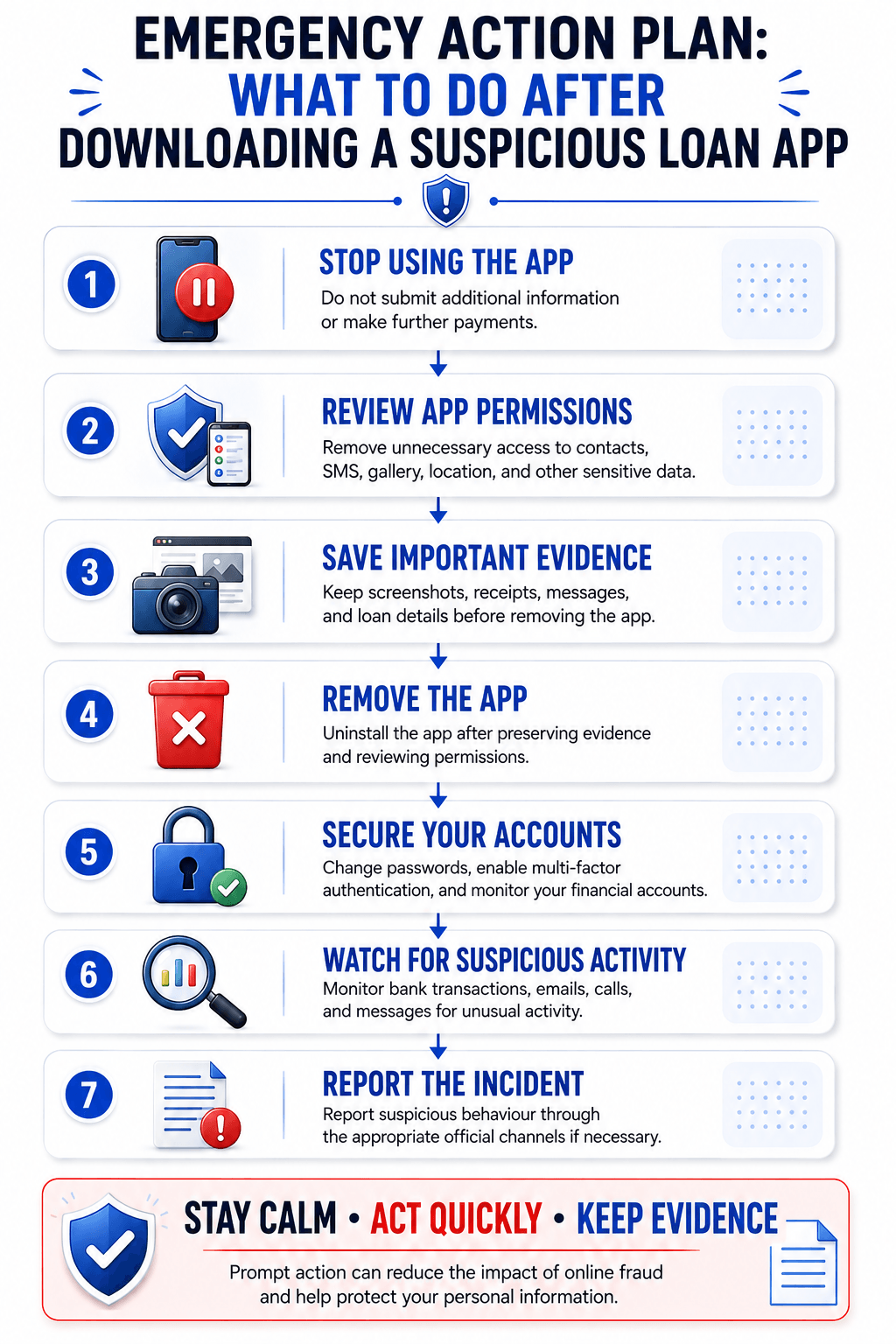
If you suspect you’ve downloaded a deceptive loan app, don’t wait until problems become worse.
Use this simple action plan.
 EMERGENCY ACTION PLAN

1. Stop using the app.
          │
          ▼
2. Revoke unnecessary permissions.
          │
          ▼
3. Save important evidence.
          │
          ▼
4. Remove the app.
          │
          ▼
5. Secure important accounts.
          │
          ▼
6. Monitor for suspicious activity.
          │
          ▼
7. Report the incident if necessary.
Think of this as your digital first-aid checklist.
The earlier you act, the more opportunities you have to limit further harm.
Step 1: Stop Sharing Additional Information
If you begin to suspect that a loan app is not trustworthy, stop interacting with it immediately.
Avoid:
- uploading additional identity documents;
- sending further payments;
- sharing passwords or PINs;
- providing one-time passwords (OTPs);
- completing extra verification requests without first confirming they are legitimate.
Some scammers deliberately request more information after borrowers become emotionally invested.
Don’t allow urgency or pressure to influence your judgement.
Why This Matters
Every additional piece of information you share increases the amount of data that could potentially be misused.
Stopping early limits your exposure.
Step 2: Review the Permissions You’ve Granted
Before uninstalling the app, review what permissions it currently has.
Many smartphones allow you to manage permissions individually through the device settings.
Pay particular attention to whether the app can access your:
- Contacts
- SMS
- Camera
- Microphone
- Call history
- Photo gallery
- Files
- Location
If a permission appears unnecessary for a loan application, revoke it before removing the app where possible.
Pro Tip
Reviewing app permissions should become a regular habit—not just after installing loan apps.
Many legitimate applications also request more access than they genuinely need.
Good digital hygiene begins with understanding what information your apps can see.
Step 3: Preserve Important Evidence
Many people immediately delete a suspicious app.
While removing the app may eventually be appropriate, avoid deleting valuable evidence first.
Before uninstalling the app, consider saving:
- screenshots of the application;
- payment receipts;
- loan agreements;
- conversations with customer support;
- threatening messages;
- email correspondence;
- transaction references; and
- the app’s name and developer information (if available).
These records may become useful if you later need to explain what happened or report the incident.
Documentation Checklist
Before removing the app, try to collect:
✅ Screenshots of the app.
✅ Payment confirmations.
✅ Bank transaction references.
✅ Text messages and emails.
✅ Phone numbers used to contact you.
✅ Copies of any loan agreement or repayment schedule.
✅ Dates and times of important events.
Good documentation makes it easier to explain your situation accurately if further action becomes necessary.
Step 4: Remove the App
Once you’ve revoked unnecessary permissions and saved important evidence, uninstall the application if you no longer trust it.
Removing the app can help prevent further interaction between the software and your device.
However, remember:
Deleting an app does not necessarily erase information that has already been collected or transmitted.
This is why acting early is so important.
Myth vs Fact
Myth
“If I delete the app, all my information disappears.”
Fact
Deleting the app removes it from your device, but it does not automatically remove any information that may already have been shared with the company or transmitted while the app was installed.
Step 5: Secure Your Important Accounts
If you’ve shared sensitive information, it’s sensible to review the security of your important accounts.
Depending on the information disclosed, consider:
- changing passwords for important online accounts;
- enabling multi-factor authentication (MFA) where available;
- reviewing recent account activity;
- monitoring bank transactions carefully; and
- updating recovery information if necessary.
You don’t need to panic.
Think of this as a precaution—similar to changing the locks after losing a house key.
Recovery Timeline
Knowing what to do—and when—can make the situation feel much more manageable.
Within the First Hour
- Stop using the app.
- Revoke unnecessary permissions.
- Save screenshots and other evidence.
- Avoid making additional payments.
Within the First 24 Hours
- Remove the app if appropriate.
- Change passwords for important accounts if necessary.
- Enable MFA wherever possible.
- Monitor your financial accounts.
During the Following Week
- Watch for suspicious phone calls, emails, or text messages.
- Continue reviewing your bank transactions.
- Keep your documentation organised.
- Consider reporting the incident if you believe deceptive practices or fraud may have occurred.
What Not to Do
When people panic, they sometimes make decisions that create additional problems.
If you suspect you’ve interacted with a deceptive loan app, avoid these common mistakes:
❌ Don’t send more money simply because someone threatens you.
❌ Don’t share passwords, PINs, or OTPs.
❌ Don’t delete important evidence before saving it.
❌ Don’t ignore suspicious financial transactions.
❌ Don’t assume deleting the app automatically removes your personal information from the company’s systems.
❌ Don’t allow embarrassment to stop you from seeking help if you need it.
Emotional Reassurance
If you’ve fallen victim to a deceptive loan app, remember this:
You’re not alone.
Fraudsters deliberately exploit financial pressure, urgency, trust, and human psychology.
People from all backgrounds—including experienced professionals and technologically confident users—have fallen victim to sophisticated online scams.
The important thing is not dwelling on what happened, but responding quickly and taking practical steps to protect yourself.
Every action you take now helps reduce future risk.
Key Takeaways
If you suspect you’ve downloaded a deceptive loan app:
- Stay calm and act methodically.
- Stop sharing additional information immediately.
- Revoke unnecessary permissions before uninstalling the app.
- Save evidence before deleting anything.
- Strengthen the security of your important accounts.
- Continue monitoring for suspicious activity during the days that follow.
Recovering from a suspicious loan app isn’t just about removing software—it’s about protecting your identity, your finances, and your digital life.
Reporting Suspicious Loan Apps, Borrowing Safely, and Protecting Yourself in the Future
By now, you’ve learned:
- how fake loan apps operate;
- the warning signs to watch for;
- how to verify a lender before borrowing; and
- what to do if you’ve already interacted with a suspicious app.
The final step is knowing where to seek help, how to report suspicious activity, and how to borrow more safely in the future.
Remember, staying safe isn’t about avoiding technology—it’s about using it wisely.
How to Report Suspicious Loan Apps in Nigeria
If you believe a loan app has engaged in deceptive, abusive, or fraudulent practices, reporting the incident can help protect both you and other potential victims.
Depending on the nature of your complaint, you may consider reporting it through the appropriate official channels.
Consumer Protection Concerns
If your complaint involves:
- misleading advertising;
- unfair treatment;
- hidden charges;
- abusive debt collection practices; or
- other consumer-related concerns,
you can consider reporting the matter to the Federal Competition and Consumer Protection Commission (FCCPC), Nigeria’s consumer protection authority.
Financial or Regulatory Concerns
If your concern relates to financial services, payment issues, or regulated financial activities, you may also need to contact the appropriate financial regulator or your financial institution, depending on the circumstances.
If money has been taken from your account without your authorisation, contact your bank immediately.
The earlier suspicious activity is reported, the greater the opportunity to limit further losses.
Cybercrime or Fraud
If you believe you have become the victim of fraud, identity theft, or another cyber-related offence, you should consider reporting the incident to the appropriate law enforcement authorities.
Where cybercrime is suspected, preserving evidence before making a report can significantly assist any investigation.
Report the App Store Listing
If you downloaded the application through an official app marketplace, you can also report the app using the marketplace’s built-in reporting tools.
User reports help app stores investigate potentially harmful applications and, where appropriate, remove them.
Before You Report: Gather Your Evidence
Well-organised evidence makes it easier to explain what happened.
Before submitting a complaint, try to collect:
Identity of the App
- App name
- Developer name (if available)
- Version number
- Download source
Financial Information
- Payment receipts
- Bank transaction references
- Loan amount
- Repayment records
Communications
- Screenshots
- Emails
- SMS messages
- WhatsApp conversations (if applicable)
- Call records
Other Useful Information
- Dates and times of important events
- Copies of the loan agreement
- Photographs of threatening messages
- Notes describing what happened
Keeping information organised will make it easier to explain your experience clearly.
When Should You Seek Additional Help?
Some situations require more than simply uninstalling an app.
Seek additional assistance if you notice:
- unauthorised bank transactions;
- someone attempting to access your financial accounts;
- evidence that your identity has been misused;
- continuing harassment or intimidation;
- suspicious activity involving your personal information.
Acting promptly often reduces the impact of online fraud.
If you’re uncertain about what to do, contact your financial institution or the appropriate authority as soon as possible.
Safer Ways to Borrow Money Online
Digital lending can be a legitimate and helpful financial tool when used responsibly.
The safest borrowers usually follow a simple process before applying.
1. Compare More Than One Lender
Avoid accepting the first offer you receive.
Comparing lenders gives you a better understanding of:
- repayment terms;
- interest and fees;
- customer support; and
- overall transparency.
2. Understand the Total Cost of Borrowing
Don’t focus only on:
“How much can I borrow?”
Also ask:
- What is the total repayment amount?
- Are there additional charges?
- What happens if I repay early?
- What happens if I miss a payment?
Understanding the full cost helps you make informed financial decisions.
3. Borrow Only What You Need
Borrowing more than necessary increases financial pressure later.
Responsible borrowing means matching the loan amount to your actual need and your realistic ability to repay.
4. Read Before You Agree
Never skip:
- the loan agreement;
- privacy policy;
- repayment schedule; or
- important terms and conditions.
Reading first often prevents unpleasant surprises later.
5. Protect Your Personal Information
Treat your personal information as carefully as your money.
Only provide information that appears necessary, and only after you are satisfied that the lender is transparent about why it is being collected.
Frequently Asked Questions
Are all loan apps in Nigeria fake?
No.
Many digital lenders operate responsibly and provide legitimate financial services.
This guide is intended to help you distinguish transparent lenders from deceptive or unethical operators.
Can fake loan apps access my contacts?
Only if you grant permission.
Always review permission requests carefully before tapping Allow, and ask whether the requested access is genuinely necessary.
Does deleting a loan app remove my personal information?
Not necessarily.
Deleting an app removes it from your device, but it does not automatically delete information that may already have been shared or transmitted while the app was installed.
This is why reviewing permissions, preserving evidence, and securing your accounts are equally important.
Is every app in an official app store safe?
No review process is perfect.
Official app stores provide an important layer of protection, but borrowers should still independently verify the lender, review permissions, and understand the loan terms.
Should I pay a processing or activation fee before receiving my loan?
Unexpected requests for payment before loan disbursement deserve careful scrutiny.
Before making any payment, understand exactly why it is required and ensure the explanation is consistent with the lender’s published terms.
What if I feel pressured to make a decision immediately?
Pause.
Legitimate financial decisions rarely become worse because you spent extra time verifying the lender.
Rushed decisions often benefit scammers—not borrowers.
Final Borrowing Checklist
Before applying for any online loan, work through this checklist:
Step 1: Research
☐ Do I know who owns this company?
☐ Have I visited the official website?
☐ Have I checked independent reviews?
Step 2: Understand
☐ Do I understand the repayment terms?
☐ Do I know the total cost of borrowing?
☐ Have I read the privacy policy?
Step 3: Verify
☐ Do the requested permissions make sense?
☐ Can I easily contact the company?
☐ Do I feel informed rather than pressured?
Step 4: Decide
If you answered “No” to several of these questions, take more time to investigate before applying.
A trustworthy lender should welcome informed customers—not discourage careful decision-making.
Final Thoughts
Financial emergencies can happen to anyone.
Needing financial assistance is not a sign of poor judgement, and using digital lending services is not inherently unsafe.
The real challenge is distinguishing responsible lenders from deceptive operators.
Throughout this guide, you’ve learned that fake loan apps often rely on urgency, unrealistic promises, excessive data collection, and intimidation—not transparency or trust.
The most effective protection isn’t becoming an expert in cybersecurity.
It’s developing a simple habit:
Pause. Verify. Decide.
Whenever you’re considering an online loan, remember these three principles:
- Verify the lender before sharing your information.
- Understand the loan before accepting it.
- Protect your personal information as carefully as your money.
Following these habits won’t eliminate every risk, but they will significantly improve your ability to make informed decisions and avoid many common digital lending scams.
Remember: Verify first. Borrow second.
Let that become your personal rule whenever you encounter an online loan offer.
Continue Building Your Digital Safety Skills
Protecting yourself from fake loan apps is just one part of staying safe online.
To strengthen your digital security knowledge, we recommend exploring these related guides on 9jaScope:
- Internet Safety in Nigeria – Learn practical habits for protecting your personal information, recognising common online threats, and browsing more safely.
- WhatsApp Scams in Nigeria – Discover how fraudsters use messaging apps to deceive victims and the warning signs to watch for before responding to suspicious messages.
The more you understand digital threats, the better equipped you’ll be to protect yourself, your family, and your finances in an increasingly connected world.
Final Key Takeaways
Before you borrow online, remember these essential lessons:
- Verify before you trust.
- Read before you agree.
- Question unrealistic promises.
- Protect your personal information.
- Review app permissions carefully.
- Keep records if something goes wrong.
- Report suspicious behaviour through the appropriate channels.
- Never allow urgency to replace informed decision-making.
By applying these principles consistently, you’ll be in a much stronger position to avoid deceptive loan apps and make safer financial decisions in the future.
Thank You for Reading
If you found this guide helpful, consider sharing it with friends, family, or colleagues. Raising awareness about fake loan apps can help more people recognise warning signs early and make safer decisions before they become victims. Together, informed consumers can make it harder for scammers to succeed and contribute to a safer digital environment for everyone.