
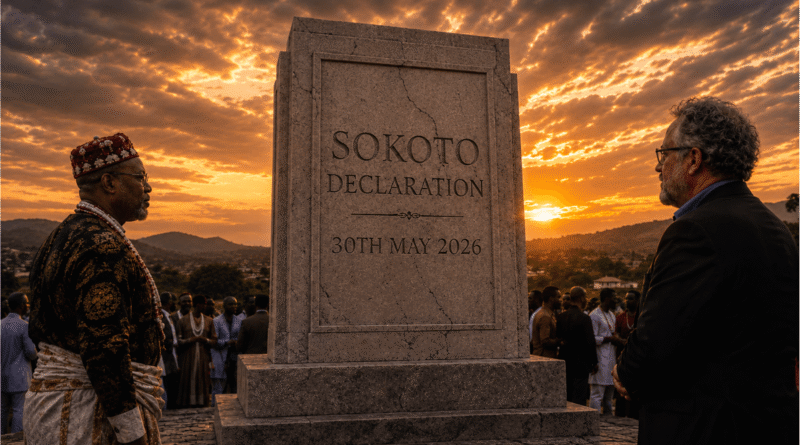
What Is the Sokoto Declaration? Why Biafra Heroes Day 2026 Sparked New Debate on Self-Determination
Key Takeaways
- Biafra Heroes Day 2026 became one of the most politically significant May 30 observances in recent years following the release of the Sokoto Declaration.
- The declaration presents a framework built around self-determination, constitutional legitimacy, democratic consent, resource ownership, and political reform.
- The document has generated both support and criticism across Nigeria and among diaspora communities.
- Supporters view it as a roadmap for peaceful political change, while critics question aspects of its historical interpretations and practical implementation.
- The declaration’s significance extends beyond Biafra and touches broader debates surrounding governance, federalism, representation, and constitutional reform.
Few expected Biafra Heroes Day 2026 to produce one of the most discussed political documents in recent Nigerian history.
Yet by the end of May 30, conversations across social media, diaspora forums, community gatherings, churches, and political circles had shifted from remembrance activities to a newly released document known as the Sokoto Declaration.
Issued on a date deeply significant to many Biafrans, the declaration—attributed to Mazi Nnamdi Kanu and Mike Arnold—immediately generated debate about self-determination, constitutional legitimacy, democratic consent, resource ownership, political representation, and the future structure of Nigeria.
For supporters, it represents a bold political vision for the future. For critics, it raises difficult constitutional, legal, and historical questions. For neutral observers, it may become one of the most consequential political documents associated with Biafra Heroes Day in recent memory.
Whether history ultimately views the declaration as a turning point or merely another chapter in Nigeria’s long-running political conversation remains uncertain. What is clear, however, is that Biafra Heroes Day 2026 became far more than a day of remembrance.
Table of Contents
Why Biafra Heroes Day Continues to Matter
More than five decades after the Nigerian Civil War ended, May 30 remains one of the most emotionally significant dates for millions of people across the former Eastern Region and the global Biafran diaspora.
The date commemorates the declaration of the Republic of Biafra in 1967 and serves as an occasion to remember those who lost their lives during one of Africa’s most devastating conflicts.
For many families, Biafra Heroes Day remains deeply personal.
Some remember relatives who never returned from the war. Others reflect on stories of displacement, starvation, survival, and resilience passed down through generations. Churches hold memorial services, communities organize remembrance events, and younger generations seek to understand a conflict whose effects continue to influence contemporary political discussions.
For many Biafrans, the day serves three purposes:
- Remembering the fallen.
- Reflecting on the lessons of history.
- Discussing the future.
It is this third purpose that helps explain why the Sokoto Declaration attracted such widespread attention.
Why the Sokoto Declaration Is Generating So Much Attention
Several factors explain why the declaration quickly became one of the most discussed political developments associated with Biafra Heroes Day.
It Was Released on Biafra Heroes Day
The timing alone guaranteed attention.
May 30 is arguably the most symbolically important date in the Biafran calendar. Releasing a major political document on this date ensured that it would immediately become part of the broader conversation surrounding remembrance and self-determination.
It Is Linked to Nnamdi Kanu
Any major political statement associated with Mazi Nnamdi Kanu is likely to attract substantial public interest because of his central role in contemporary self-determination debates.
It Extends Beyond Biafra
Unlike many previous statements focused primarily on Biafra, the declaration explicitly references Yoruba communities, Middle Belt populations, northern minorities, and other groups seeking political reform and greater representation.
It Focuses on Future Political Arrangements
Rather than concentrating exclusively on historical grievances, the declaration proposes a future-oriented framework built around constitutional reform, democratic consent, political accountability, and self-determination.
Its Language Is Direct
Several sections employ language that supporters view as courageous and critics view as controversial, contributing significantly to public debate.
Why Was the Declaration Released on May 30?
Political symbolism matters.
The decision to release the declaration on May 30 appears intended to connect remembrance of the past with discussions about the future.
Supporters argue that honoring those who suffered during the Civil War should include examining unresolved political questions that continue to affect many communities today.
Critics argue that linking remembrance events to contemporary political campaigns risks deepening divisions and politicizing historical memory.
Regardless of perspective, the timing ensured that the declaration became one of the defining political stories of Biafra Heroes Day 2026.
Timeline: From Biafra to the Sokoto Declaration
1967
The Republic of Biafra was declared on May 30.
1967–1970
The Nigerian Civil War left millions affected by violence, displacement, and a humanitarian crisis.
1969
The Ahiara Declaration is issued as Biafra’s principal ideological statement.
1970
The war ends and Biafra is reintegrated into Nigeria.
2015
The Indigenous People of Biafra (IPOB) gains renewed international visibility.
2021
Nnamdi Kanu’s rendition and detention became major political issues.
2025
Kanu is convicted on terrorism-related charges and sentenced to life imprisonment by the Federal High Court in Abuja. His legal team rejects the ruling and files an appeal.
2026
The Sokoto Declaration was released during the Biafra Heroes Day commemorations.
The Legal Controversy Surrounding Nnamdi Kanu
The release of the Sokoto Declaration comes against the backdrop of continuing legal and political controversy surrounding Mazi Nnamdi Kanu.
Kanu and his legal team rejected the judgment and announced plans to appeal.
His lawyers have consistently challenged the court’s jurisdiction and argued that the prosecution lacked a valid legal foundation. They have also maintained that his 2021 transfer from Kenya to Nigeria was unlawful and constituted extraordinary rendition rather than lawful extradition.
Supporters of Kanu frequently argue that questions surrounding his rendition, detention, conviction, and appeal form an important backdrop to understanding both the Sokoto Declaration and the continuing self-determination debate in southeastern Nigeria.
Critics, however, maintain that the focus should remain on the court’s findings and the criminal charges rather than the political implications of the case.
What the Sokoto Declaration Actually Says
The declaration presents itself as a collection of principles addressing governance, liberty, justice, constitutional legitimacy, and self-determination.
Government Legitimacy Comes From the People
One of the declaration’s central arguments is that governments derive legitimacy from the consent of the governed.
Self-Determination Is Not a Crime
Perhaps the declaration’s most widely discussed statement is:
“Self-determination is not a crime.”
The declaration extends this principle beyond Biafra to include other groups seeking democratic means of determining their political future.
Resource Ownership and Economic Justice
The declaration argues that natural resources should primarily benefit the communities in which they are located and criticizes situations where wealth is extracted while local populations remain impoverished or insecure.
Power Must Be Built
The declaration states:
“Power is never given. It is built.”
Supporters interpret this as a call for civic engagement, organization, and sustained democratic participation.
Unity Over Division
Another notable section warns:
“Unity, or ruin.”
The declaration argues that political movements weaken themselves when internal divisions overshadow shared objectives.
Constitutional Reform and Referendum
The declaration advocates constitutional reform through peaceful and democratic means and calls for an internationally supervised referendum.
Ahiara Declaration vs. Sokoto Declaration
Comparisons between the Sokoto Declaration and the historic Ahiara Declaration have become increasingly common.
Ahiara Declaration (1969)
- Produced during wartime.
- Focused on Biafran nationhood and survival.
- Explained the ideological foundations of the Biafran state.
- Addressed the immediate realities of armed conflict.
Sokoto Declaration (2026)
- Produced during peacetime.
- Focuses on constitutional legitimacy and democratic consent.
- Expands beyond Biafra to multiple ethnic nationalities.
- Emphasizes constitutional reform, self-determination, and political restructuring.
The Ahiara Declaration asked:
Why must Biafra survive?
The Sokoto Declaration asks:
How should communities respond when they believe existing political systems no longer represent their interests?
Could the Sokoto Declaration Become a Historic Document?
History shows that most political declarations disappear shortly after publication.
A smaller number become reference points that continue to influence public discussions decades later.
Supporters frequently compare the Sokoto Declaration to the Ahiara Declaration because both attempt to articulate a broader political vision rather than merely react to immediate events.
Whether the Sokoto Declaration will achieve similar historical significance remains uncertain.
Its long-term influence will likely depend on whether its ideas shape future discussions surrounding constitutional reform, governance, self-determination, and national identity.
What is already clear is that the declaration has generated discussion far beyond the immediate circle of its authors and supporters.
Why the Declaration Matters Beyond Biafra
Although it emerged from discussions associated with the Biafra movement, the declaration’s scope extends beyond Biafran issues alone.
The document explicitly references Yoruba communities, Middle Belt populations, northern minorities, and other groups seeking greater political representation or constitutional reform.
As a result, some observers view it less as a Biafra-specific document and more as a broader intervention in debates surrounding governance, federalism, citizenship, self-determination, and democratic legitimacy.
This broader framing may ultimately become one of the declaration’s most consequential features.
Supporters’ Perspective
Supporters describe the declaration as one of the most comprehensive political statements to emerge from the self-determination movement in recent years.
They argue that it:
- Frames self-determination as a democratic right.
- Encourages constitutional rather than military solutions.
- Broadens discussions beyond ethnicity.
- Emphasizes democratic participation and political organization.
- Provides a future-oriented political framework.
Many supporters believe the document attempts to move the conversation away from historical grievances alone and toward practical political engagement.
Critics’ Perspective
Critics raise several concerns.
They argue that:
- Some historical interpretations remain disputed.
- The legal pathway for implementing certain proposals is unclear.
- The referendum proposal may face constitutional challenges.
- Some recommendations may be difficult to implement within Nigeria’s existing political framework.
These concerns have fueled substantial debate since the declaration’s release.
What Could the Declaration Mean for the Future?
The long-term significance of the Sokoto Declaration remains uncertain.
However, several possibilities are already emerging.
It could increase international attention on self-determination discussions.
It could contribute to renewed national conversations about restructuring, federalism, and constitutional reform.
It could encourage greater cooperation among communities seeking political change through democratic means.
Alternatively, it could become another contested political document whose ultimate influence depends less on its contents and more on how future events unfold.
Frequently Asked Questions
What is the Sokoto Declaration?
The Sokoto Declaration is a political document released on May 30, 2026, discussing self-determination, constitutional legitimacy, democratic consent, resource ownership, and political reform.
Who is associated with the declaration?
The document has been publicly attributed to Mazi Nnamdi Kanu and Mike Arnold.
Why is it called the Sokoto Declaration?
According to its promoters, the title carries symbolic significance connected to broader historical and political questions as well as the circumstances surrounding Nnamdi Kanu’s detention.
Is the Sokoto Declaration a declaration of Biafran independence?
No. The document is generally presented as a political manifesto advocating self-determination, constitutional reform, and democratic processes rather than a formal declaration of independence.
Does the declaration call for a referendum?
Yes. One of its proposals is an internationally supervised referendum connected to broader constitutional reform and self-determination discussions.
What is the difference between the Ahiara Declaration and the Sokoto Declaration?
The Ahiara Declaration was produced during the Nigerian Civil War and focused on Biafra’s wartime ideology and survival. The Sokoto Declaration was produced during peacetime and focuses more broadly on constitutional legitimacy, democratic consent, political reform, and self-determination.
Conclusion
More than fifty years after the Nigerian Civil War ended, debates over identity, representation, governance, constitutional legitimacy, and political destiny remain unresolved.
Whether the Sokoto Declaration ultimately becomes a milestone in the history of self-determination movements or simply another entry in Nigeria’s long tradition of political manifestos remains uncertain.
What cannot be disputed is that its release transformed Biafra Heroes Day 2026 from a day focused primarily on remembrance into a day of renewed political conversation.
For supporters, it represents a vision for democratic self-determination and constitutional reform. For critics, it raises difficult legal, historical, and political questions. For observers, it stands as one of the most significant political documents associated with this year’s Biafra Heroes Day observance.
More than half a century after the guns of the civil war fell silent, the questions that shaped one generation continue to confront another. Whether the Sokoto Declaration becomes a catalyst for change or merely a footnote in history will depend not on the document itself, but on how future generations respond to the ideas it contains.




Pingback: Why the Victor Solomon Case Still Divides Opinion in Southern Kaduna