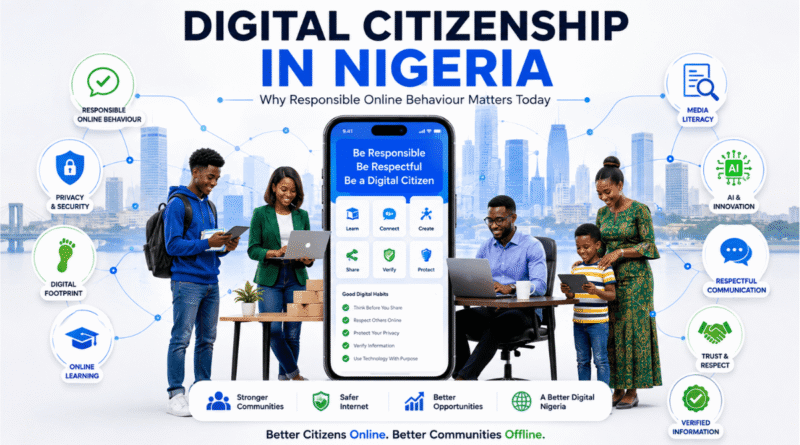
Digital Citizenship in Nigeria: Why Responsible Online Behaviour Matters Today
Every day, millions of Nigerians send messages, make online payments, watch videos, attend virtual classes, shop on digital marketplaces and connect with family, friends and colleagues through the internet. These activities have become so routine that most people rarely stop to think about them. Yet every message sent, every comment posted and every piece of information shared quietly shapes personal reputations, influences public conversations and contributes to the kind of digital society we all experience.
Imagine a typical day. A university student forwards a breaking news story to several WhatsApp groups without checking whether it is true. A young entrepreneur enthusiastically shares what appears to be a genuine giveaway on Facebook, only to discover later that it was fraudulent. In another part of the country, someone posts an insulting comment beneath a viral video, believing that words written online carry fewer consequences than words spoken face to face. Meanwhile, a member of a family WhatsApp group forwards an alarming voice note that spreads unnecessary fear because no one pauses to verify its source.
None of these people intended to cause harm, yet each decision demonstrates how ordinary online behaviour can affect individuals, families and entire communities. These everyday situations all point to one important idea—Digital Citizenship in Nigeria.
As more Nigerians rely on the internet for communication, education, banking, business, entertainment and public discussion, responsible online behaviour has become just as important as digital skills. Knowing how to use a smartphone, social media platform or banking application is valuable, but knowing how to use them responsibly is becoming equally important.
Much of the conversation about life online focuses on protecting ourselves from cyber threats such as scams, phishing attacks and malicious software. Those discussions remain essential, especially as digital fraud continues to evolve. However, technology alone cannot create a safer internet. The quality of our online experience also depends on how we communicate, what we choose to share, how we verify information and how we treat other people in digital spaces.
Understanding responsible online behaviour works alongside good internet safety practices rather than replacing them. While internet safety helps protect people from digital threats, digital citizenship focuses on how each of us contributes to a healthier, more trustworthy online environment.
This guide explores that human side of technology. Rather than teaching you how to secure your devices, it explains how responsible online behaviour can help protect your reputation, strengthen trust, improve digital communities and make the internet a better place for everyone.
At a Glance
Before we explore the topic in detail, here are four ideas worth remembering:
- Digital citizenship is not simply about using technology—it is about using it responsibly, respectfully and thoughtfully.
- Small everyday choices, such as verifying information before forwarding it or treating others with respect online, have a lasting impact on digital communities.
- Internet safety protects you from online threats, while digital citizenship guides how you interact with people, information and technology.
- Becoming a better digital citizen benefits not only you but also your family, workplace, school and the wider community.
Did You Know?
Every message you forward, every photograph you upload and every comment you publish contributes to your digital footprint. Even if content is deleted later, screenshots, archives or copies shared by others may continue to exist. Increasingly, universities, employers and business partners review a person’s online presence before making important decisions.
Why Digital Citizenship in Nigeria Matters Today
Nigeria’s digital transformation has accelerated rapidly over the past decade. Smartphones have become more accessible, internet connectivity has expanded and digital services now support many aspects of everyday life. Banking transactions are completed through mobile applications, students attend virtual classes, entrepreneurs sell products through online marketplaces, professionals participate in virtual meetings and families remain connected across different cities and countries through messaging platforms.
According to the Nigerian Communications Commission (NCC), Nigeria recorded more than 157 million active internet subscriptions as of May 2026. Although internet subscriptions do not represent unique internet users, the data illustrates the country’s widespread adoption of digital services and increasing reliance on online platforms for communication, banking, and financial transactions.
Many Nigerians now begin and end their day online. The first activity in the morning may be checking WhatsApp messages from family members, reading overnight headlines or responding to work emails. Throughout the day, people pay bills digitally, order products online, participate in virtual meetings, study through educational platforms and interact on social media. By evening, entertainment, shopping and conversations often continue through the same digital devices.
The internet is no longer simply a tool—it has become an extension of everyday life, influencing how people learn, work, communicate, shop, build relationships and even make important personal decisions.
As online participation grows, so do the responsibilities that come with it. A careless social media post can affect professional credibility. An unverified WhatsApp broadcast can spread misinformation across communities within minutes. Sharing another person’s photograph without permission may violate their privacy, while abusive comments can damage relationships and contribute to unhealthy online environments.
Digital behaviour no longer stays online. It increasingly influences educational opportunities, career prospects, business credibility, public trust and personal reputation. Understanding Digital Citizenship in Nigeria is therefore becoming an essential life skill rather than an optional one.
What Is Digital Citizenship in Nigeria?
Simply put, digital citizenship is the practice of using digital technology responsibly, ethically and respectfully.
It is less about how well you use technology and more about how responsibly you use it.
Being a good digital citizen does not require advanced technical knowledge or professional cybersecurity skills. Instead, it means making thoughtful decisions whenever you communicate, share information, participate in online discussions or interact with other people through digital platforms.
Whether you are participating in a neighbourhood WhatsApp group, shopping through an online marketplace, joining conversations on social media or collaborating with colleagues remotely, the same principles apply: honesty, respect, responsibility and accountability.
A responsible digital citizen understands that online actions have real-world consequences. Before forwarding a message, they ask whether it is accurate, and before posting a comment, they consider whether it is respectful. Likewise, before uploading someone else’s photograph, they think about privacy and consent. These seemingly small decisions shape the quality of the digital communities we all share.
Digital citizenship also recognises that every internet user contributes to the culture of the online spaces they join. Just as neighbourhoods become better places when residents respect one another and take responsibility for their actions, digital communities become healthier when users communicate honestly, verify information carefully and participate respectfully.
For Nigerians, where messaging apps, social media platforms and digital commerce have become central to everyday life, practising good digital citizenship helps build stronger relationships, encourages more trustworthy conversations and supports healthier online communities.
Ultimately, digital citizenship encourages a simple but powerful shift in thinking.
Instead of asking,
“Can I post this?”
ask,
“Is this accurate, respectful and necessary to share?”
That small pause before clicking Send, Share or Post often makes the difference between contributing positively to the internet and adding to misinformation, unnecessary conflict or declining public trust.
Digital Citizenship vs Internet Safety
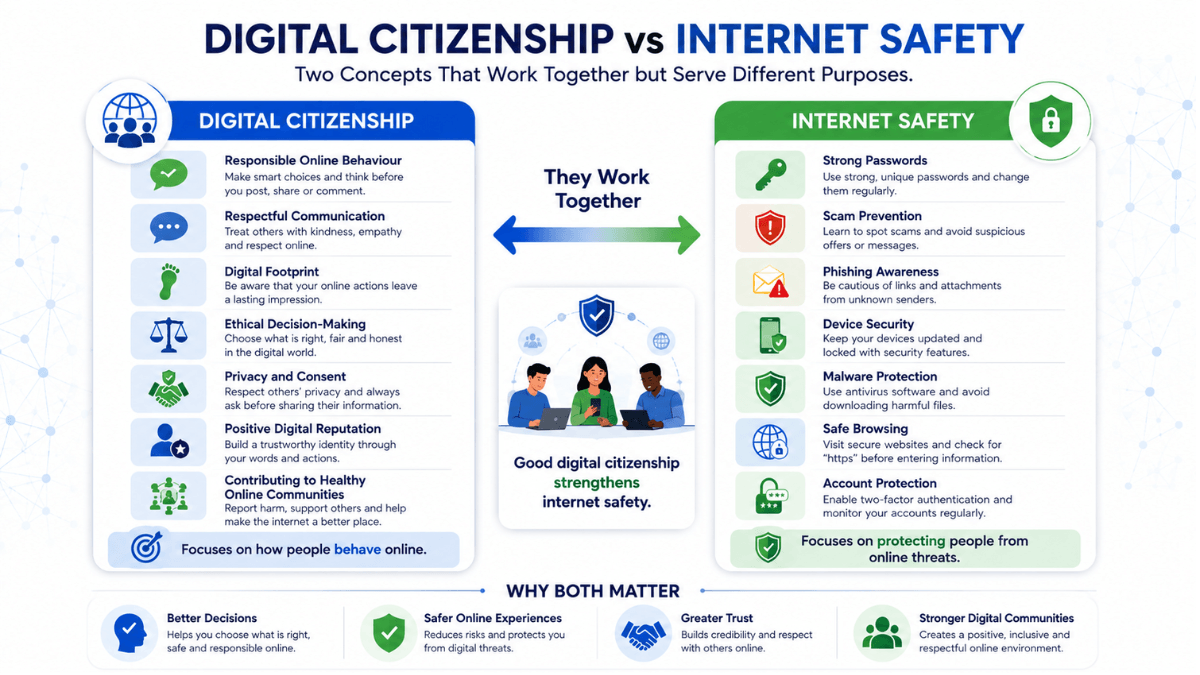
Because both concepts relate to life online, many people mistakenly believe they mean the same thing. In reality, they answer two very different questions.
Internet safety asks:
“How can I protect myself from online threats?”
Digital citizenship asks:
“How should I behave while using the internet?”
Although closely connected, they focus on different aspects of the digital experience and work best when practised together.
At a Glance
Table 1: Digital Citizenship vs Internet Safety
| Digital Citizenship | Internet Safety |
|---|---|
| Responsible online behaviour | Personal protection from online threats |
| Ethical participation | Cybersecurity practices |
| Respectful communication | Scam prevention |
| Building trust and credibility | Device and account security |
| Responsible digital choices | Risk reduction |
Think of internet safety as wearing a seatbelt while driving. It helps protect you if something unexpected happens. Digital citizenship is more like obeying traffic rules, respecting other road users and driving responsibly. One protects the individual, while the other helps create a safer environment for everyone.
If your primary concern is protecting yourself from scams, phishing attempts and other digital threats, our Internet Safety in Nigeria guide explores those practical security measures in greater detail. Digital citizenship builds upon those foundations by focusing on how we communicate, participate and contribute once we are online.
Quick Tip
Before forwarding any message, pause for a few seconds and ask yourself:
- Who created this information?
- Can I verify it from a reliable source?
- Could sharing it cause unnecessary harm or confusion?
Those few seconds can prevent misinformation from spreading to hundreds or even thousands of people.
Understanding these principles is only the first step. The real challenge lies in applying responsible online habits during everyday digital interactions. From the information we share to the conversations we join and the reputation we build, good digital citizenship is shaped by small daily choices. Those practical habits are explored in the next section.
Everyday Habits of Responsible Digital Citizens
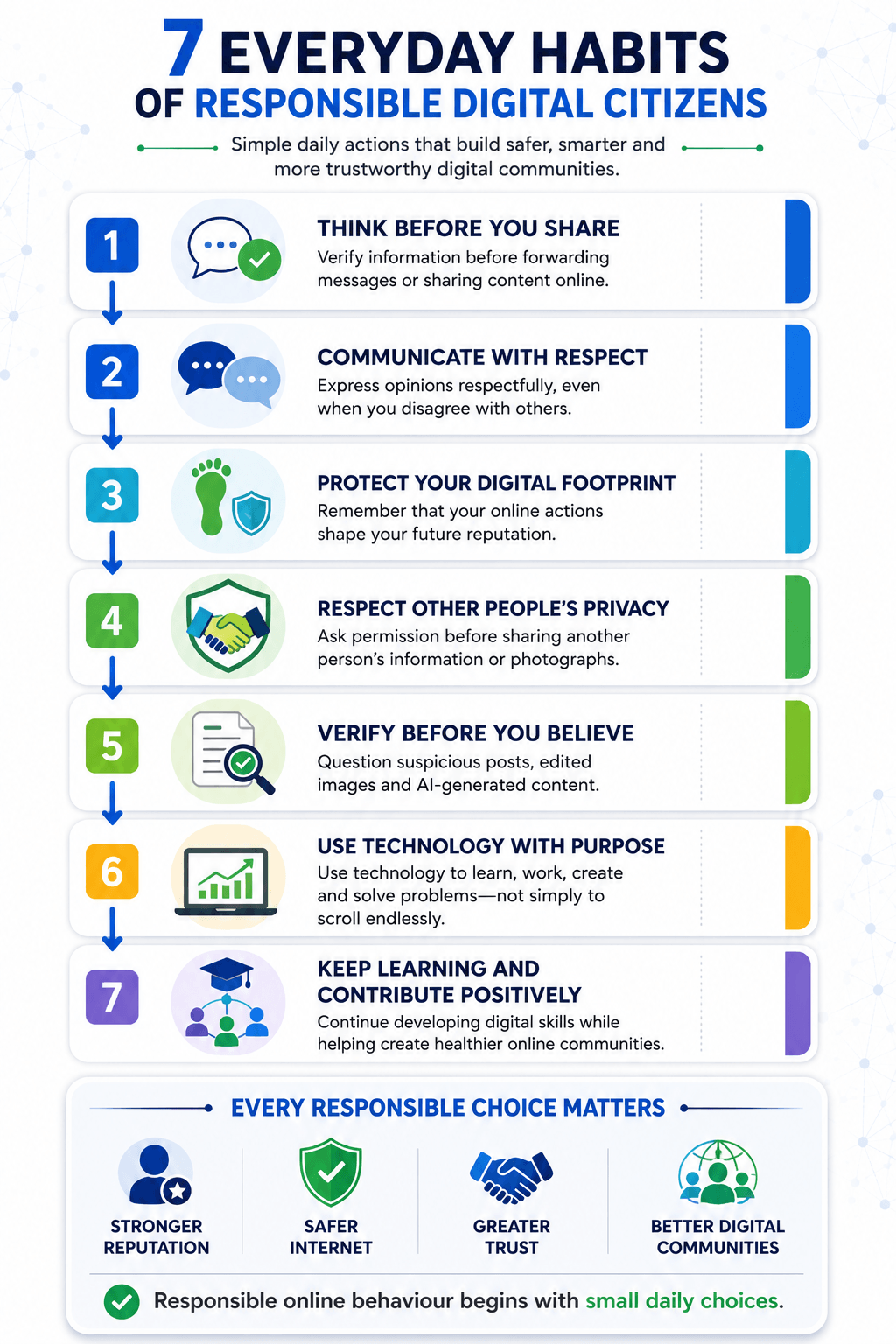
Good digital citizenship is rarely defined by one major decision. Instead, it is built through dozens of small choices made every day—often without much thought. Every message we forward, every comment we leave and every piece of information we share helps shape the quality of the online communities we belong to.
Just as trust is earned through consistent behaviour in everyday life, a strong digital reputation is built through responsible online habits. Whether you are participating in a family WhatsApp group, contributing to a professional discussion on LinkedIn or running a small business on Facebook or Instagram, the same principles of honesty, respect and responsibility apply.
Think Before You Share
A message can be forwarded in five seconds, but correcting the damage caused by false information can take days, weeks or even months.
This is one of the biggest challenges of today’s digital world. Information moves faster than ever before, but speed should never replace accuracy.
Imagine a parent receiving a voice note in a family WhatsApp group claiming that schools across a state have suddenly closed because of an emergency. Wanting to protect relatives, they forward it immediately to several contacts. Hours later, the message turns out to be false, but by then it has already spread through neighbourhood groups, school communities and workplaces, creating unnecessary confusion.
Situations like this happen every day.
Responsible digital citizens understand that sharing information carries responsibility. Before forwarding a message, they pause and ask:
- Who originally created this information?
- Can I verify it from another reliable source?
- Is the message complete, or has important context been removed?
- Could forwarding it create unnecessary fear or confusion?
Those few seconds of reflection can prevent misinformation from reaching hundreds—or even thousands—of people.
This habit is becoming even more important as artificial intelligence makes it easier to create convincing fake images, manipulated videos and fabricated screenshots. Developing strong media literacy means learning not to believe everything simply because it appears online.
Communicate With Respect
Most disagreements on the internet do not begin with hatred. They often begin with frustration, misunderstanding or the mistaken belief that online conversations carry fewer consequences than face-to-face discussions.
Yet words written online can remain visible long after emotions have faded.
A respectful digital citizen understands that disagreement does not require disrespect. It is possible to challenge ideas without attacking people.
Before responding during an online argument, consider whether the same words would be appropriate if the conversation were taking place in person. If the answer is no, they probably should not be posted online either.
Simple habits such as reading a comment one more time before publishing it, avoiding insults and focusing on ideas rather than personalities help create healthier digital conversations.
Respectful communication also sets an example for younger internet users who observe how adults interact online. Every respectful discussion contributes to a more constructive digital culture.
Protect Your Digital Footprint
Many people think of a digital footprint only when applying for a job, but in reality it begins forming from the moment we start using the internet.
Comments posted years ago, photographs shared during school, opinions expressed in frustration and even usernames chosen casually can all become part of our online identity.
Today, universities, scholarship providers, employers and professional organisations increasingly review online profiles before making important decisions. Long before meeting someone in person, they may already have formed an impression based on digital behaviour.
Protecting your digital footprint therefore means thinking beyond the present moment.
Before publishing something online, ask yourself:
“Would I still be comfortable with this post if someone important saw it five years from now?”
That simple question encourages better judgement without discouraging healthy self-expression.
Remember that building a positive digital reputation takes time, while damaging it can happen in a single careless moment.
Remember
Your digital footprint is not defined by one post—it is the sum of your online behaviour over time. Every responsible decision strengthens the reputation you build for yourself.
Respect Other People’s Privacy
One of the easiest ways to lose trust online is to ignore another person’s privacy.
Sometimes it happens unintentionally. Someone shares photographs from a wedding without asking permission. A screenshot of a private conversation is posted publicly during an argument. Hospital photographs, accident scenes or personal family matters are uploaded simply because they attract attention.
Although these actions may appear harmless, they can cause embarrassment, damage relationships and permanently affect someone’s sense of privacy.
Respecting privacy begins with a simple habit:
Ask before you share.
Whether it involves photographs, personal conversations or sensitive information, seeking permission demonstrates respect and builds trust.
A responsible digital citizen understands that not everything they can share is something they should share.
Verify Before You Believe
A convincing image is no longer proof that something actually happened. A professionally designed graphic does not automatically make the information accurate. Likewise, a viral video shared thousands of times can still be completely misleading.
Today’s digital world makes it easier than ever to manipulate information. Edited photographs, fake screenshots, misleading headlines, clipped videos taken out of context and AI-generated content are becoming increasingly difficult to distinguish from genuine material.
Imagine receiving a screenshot claiming that a well-known organisation has announced a new policy. At first glance, everything looks authentic—the logo, colours and layout all appear convincing. Yet a quick visit to the organisation’s official website reveals that no such announcement exists.
This is why verification has become one of the most valuable digital skills anyone can develop.
Responsible digital citizens avoid making decisions based solely on what they see in a single post. Instead, they compare information from trusted news organisations, official government agencies, recognised institutions or verified company websites before accepting it as true.
Verification is not about becoming suspicious of everything online. It is about developing the habit of thinking critically before believing or sharing information.
As artificial intelligence continues to improve, this habit will become even more important. AI can now generate realistic voices, convincing photographs and highly believable videos. While these technologies offer enormous opportunities for education, business and creativity, they also increase the need for stronger media literacy and critical thinking.
Use Technology With Purpose
Technology delivers the greatest value when it helps people achieve meaningful goals rather than simply filling spare moments with endless content.
Many people unlock their phones intending to reply to one message, only to realise thirty minutes later that they have been scrolling through unrelated posts, videos and recommendations. This is not always because they lack self-control; digital platforms are intentionally designed to capture attention.
Responsible digital citizens try to remain intentional about how they use technology.
Before opening an application, they often ask themselves:
“What am I hoping to achieve?”
Sometimes the answer is to complete a banking transaction, attend an online lecture or communicate with family. At other times, it may be to learn a new skill, research a business idea or explore new career opportunities.
Technology has opened remarkable opportunities for Nigerians. A university student can learn programming through online courses. A tailor can promote clothing designs to customers across different states. A small business owner can discover digital marketing strategies through educational videos. Young professionals increasingly use artificial intelligence tools to improve productivity, write reports, analyse data and automate repetitive tasks.
Technology is most valuable when it helps people solve problems, develop skills and create opportunities—not when it becomes a constant source of distraction.
Using technology with purpose does not mean avoiding entertainment. It simply means ensuring that entertainment does not replace learning, productivity, healthy relationships or personal growth.
Keep Learning
The digital world never stands still.
Every year brings new technologies, new platforms, new opportunities and unfortunately, new online threats. Fraudsters constantly change their methods. Artificial intelligence continues to evolve. Social media platforms introduce new features, while search engines and online services regularly update how they work.
Because technology changes so quickly, good digital citizenship also requires continuous learning.
This does not mean becoming a cybersecurity professional or software engineer. Instead, it means remaining curious enough to understand how new technologies affect everyday life.
Many young Nigerians now use digital platforms to discover AI tools, automation software, online learning resources, digital marketing techniques and other practical skills that improve employability and create additional sources of income. At the same time, they must also learn how to recognise AI-generated misinformation, deepfakes and increasingly sophisticated online scams.
Digital literacy, media literacy and AI literacy are no longer specialist skills reserved for technology experts. They are becoming essential life skills for anyone who wants to participate confidently and responsibly in today’s digital economy.
Learning should therefore be viewed as an ongoing habit rather than a one-time achievement.
Contribute Positively
The quality of the internet depends on the people who use it.
Every helpful answer, thoughtful discussion, educational resource and responsible decision contributes to making digital communities more useful and trustworthy.
Positive contributions do not always involve creating videos, writing articles or building large online audiences. Sometimes they involve much simpler actions.
Answering another person’s question honestly.
Reporting fraudulent accounts.
Helping someone verify suspicious information.
Sharing educational opportunities.
Encouraging respectful conversations.
Choosing not to participate in online harassment.
Each of these actions helps create healthier digital communities.
Responsible digital citizens understand that every positive contribution, no matter how small, helps strengthen public trust and encourages better online interactions for everyone.
How Good Digital Citizenship Benefits You Personally
Practising good digital citizenship is often described as something that benefits society. While that is true, the personal benefits are equally significant.
In today’s digital world, first impressions are increasingly formed long before two people meet face to-face. Employers review professional profiles. Universities examine applicants’ online presence. Clients research businesses before making purchases, while potential collaborators often search for information before agreeing to work together.
Your online reputation has become an extension of your personal reputation.
People who consistently communicate respectfully, verify information before sharing it and participate responsibly in online discussions are generally viewed as more trustworthy and professional.
Responsible online behaviour also develops valuable life skills. Learning to evaluate information carefully strengthens critical thinking. Respectful communication improves relationships. Protecting a positive digital reputation creates new educational, professional and business opportunities.
Confidence also grows naturally. People who understand how to participate responsibly online often feel more comfortable contributing to professional discussions, collaborating with others and sharing ideas constructively.
Responsible online behaviour protects far more than your devices—it protects your reputation, strengthens your relationships and creates opportunities that may benefit you for many years.
Everyday Examples of Digital Citizenship in Nigeria
Digital citizenship rarely appears through dramatic decisions. More often, it is reflected in ordinary choices that millions of Nigerians make every day without giving them much thought.
Examples include:
- Verifying a viral WhatsApp message before forwarding it to family, church, mosque, school or community groups.
- Refusing to recommend suspicious financial offers or lending platforms that cannot be independently verified. Readers interested in recognising fraudulent lending platforms can also explore our guide on Fake Loan Apps in Nigeria.
- Reporting fake social media accounts that impersonate businesses, organisations or public figures.
- Respecting the rules of workplace, neighbourhood and school WhatsApp groups instead of posting unrelated content.
- Giving proper credit when using another person’s photographs, videos or creative work.
- Avoiding plagiarism when completing assignments or publishing online content.
- Correcting misinformation politely rather than embarrassing someone who unknowingly shared incorrect information.
- Encouraging respectful discussions even when opinions differ.
Although each action appears small, together they help create digital communities built on trust, respect and responsibility.
Common Digital Citizenship Mistakes
Most people who make poor digital decisions do not intend to cause harm.
Many forward messages because they genuinely want to help friends and relatives. Others join heated online arguments because emotions temporarily outweigh good judgement. Some copy another person’s work because they believe “everyone does it,” while others share sensational content simply because it attracts attention.
Understanding these motivations is important because improving digital citizenship begins with awareness rather than blame.
Some of the most common mistakes include forwarding unverified messages, participating in online harassment, promoting fake giveaways, plagiarising other people’s work, spreading misinformation, ignoring privacy, using offensive language during disagreements and posting impulsively while angry.
Fortunately, these habits can be changed.
Remember
Responsible digital citizenship is not measured by one perfect decision. It is built through hundreds of small choices repeated consistently over time.
The habits you develop today will influence the reputation you build tomorrow. In the final part of this guide, we will explore how these principles apply to students, parents, professionals and business owners, examine how digital citizenship strengthens a safer internet, and look at the future responsibilities every Nigerian internet user should prepare for.
Digital Citizenship in Everyday Life
Digital citizenship is not reserved for technology professionals or people who spend all day online. It applies to anyone who uses a smartphone, computer or internet-connected device, regardless of age, profession or level of digital experience.
Whether you are a secondary school student preparing for examinations, a parent participating in family WhatsApp groups, a professional attending virtual meetings or a business owner selling products through social media, responsible online behaviour helps build trust, protect reputations and strengthen digital communities.
Although the principles remain the same, the way they are applied often differs depending on each person’s daily responsibilities.
Students
Today’s students have access to more knowledge than any previous generation. Online classrooms, educational videos, virtual libraries and artificial intelligence tools have transformed how learning takes place.
For many Nigerian students preparing for WAEC, NECO or JAMB, YouTube tutorials, online discussion forums and AI-powered learning tools have become valuable study companions. These technologies can simplify difficult concepts, provide practice questions and improve understanding.
However, responsible digital citizenship means using these tools to support learning rather than replace genuine effort.
Using artificial intelligence to understand Mathematics or Biology is very different from asking it to complete an assignment that is submitted as original work. Likewise, copying another person’s project without acknowledgement or sharing examination rumours without verification undermines academic integrity.
Students also contribute positively by respecting classmates in online learning groups, avoiding cyberbullying and verifying information before forwarding it to school WhatsApp groups or social media communities.
Developing these habits early prepares young people not only for higher education but also for responsible participation in the workplace and wider society.
Parents
Parents now play two important roles: raising children in the physical world and guiding them through the digital one.
Many children receive their first smartphones while still in secondary school. They quickly become familiar with social media, online gaming, video-sharing platforms and messaging applications, often long before they fully understand the responsibilities that accompany digital participation.
Children learn digital habits largely by observing adults.
When parents verify information before forwarding WhatsApp messages, communicate respectfully online, ask permission before sharing family photographs and maintain healthy screen habits, children naturally begin to imitate those behaviours.
Open conversations are usually more effective than strict restrictions alone.
Instead of focusing only on limiting screen time, parents can discuss misinformation, privacy, cyberbullying, artificial intelligence, responsible social media use and respectful online communication.
Teaching children how to think critically online is often more valuable than simply telling them what they should avoid.
Professionals
Professional reputations increasingly extend far beyond the office.
Today’s workplace often includes emails, LinkedIn profiles, Microsoft Teams meetings, Zoom conferences and other digital communication platforms. For many professionals, these interactions create first impressions long before meeting colleagues or clients in person.
Responsible professionals communicate respectfully, verify information before sharing it and maintain appropriate boundaries between personal and professional interactions.
Simple habits—such as writing courteous emails, protecting confidential information, avoiding emotional online arguments and acknowledging reliable sources—strengthen professional credibility over time.
Digital citizenship also encourages professionals to continue learning as technology evolves. New digital tools, artificial intelligence and changing workplace technologies require continuous learning and adaptability.
A strong professional reputation is now built not only through competence, but also through responsible digital behaviour.
Business Owners
Trust remains one of the most valuable assets any business can build.
Whether selling products through Instagram, Facebook Marketplace, WhatsApp Business or a dedicated e-commerce website, customers increasingly judge businesses by how they communicate online as much as by the products they sell.
Responsible business owners advertise honestly, respond professionally to customer enquiries and avoid exaggerated or misleading claims designed only to attract attention.
Protecting customer information, respecting privacy, delivering transparent communication and responding constructively to complaints all contribute to long-term customer confidence.
Businesses that consistently demonstrate honesty, professionalism and accountability online often build stronger brands than those relying on deceptive marketing tactics.
Digital citizenship therefore becomes a business advantage as well as an ethical responsibility.
How Digital Citizenship Supports a Safer Internet
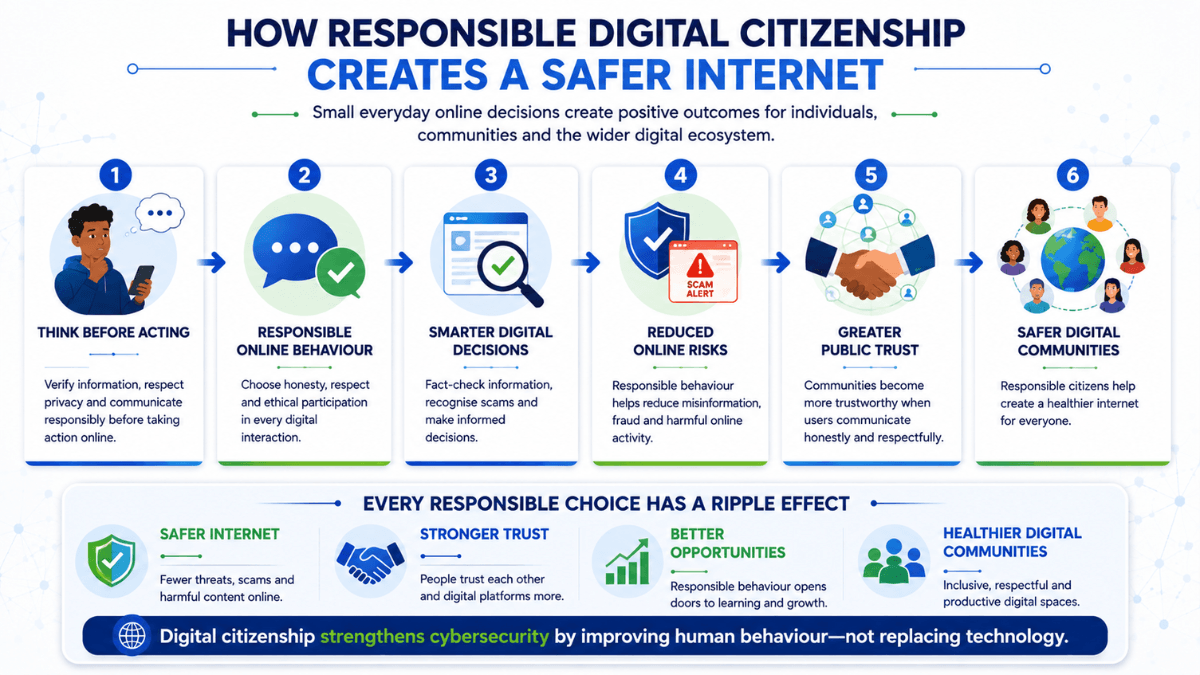
Creating a safer internet requires far more than technology.
Strong passwords, antivirus software, multi-factor authentication and secure devices remain essential, but they cannot stop people from spreading misinformation, forwarding scams or participating in harmful online behaviour.
Digital citizenship fills that important gap.
People who verify information before sharing it reduce misinformation.
People who question suspicious financial offers reduce opportunities for scammers.
People who communicate respectfully encourage healthier online communities.
People who report fake accounts and fraudulent pages help protect countless others from becoming victims.
Every responsible internet user becomes another barrier against misinformation, scams and online abuse.
This is why digital citizenship and internet safety should always be viewed as complementary rather than competing ideas.
If your goal is to strengthen your online security, our Internet Safety in Nigeria guide explains practical ways to protect yourself against phishing attacks, malware and other cyber threats. Likewise, understanding the warning signs discussed in our articles on Fake Loan Apps in Nigeria and WhatsApp Account Scams can further reduce your exposure to online fraud.
Responsible online behaviour strengthens cybersecurity—it does not replace it.
Looking Ahead: The Future of Digital Citizenship in Nigeria
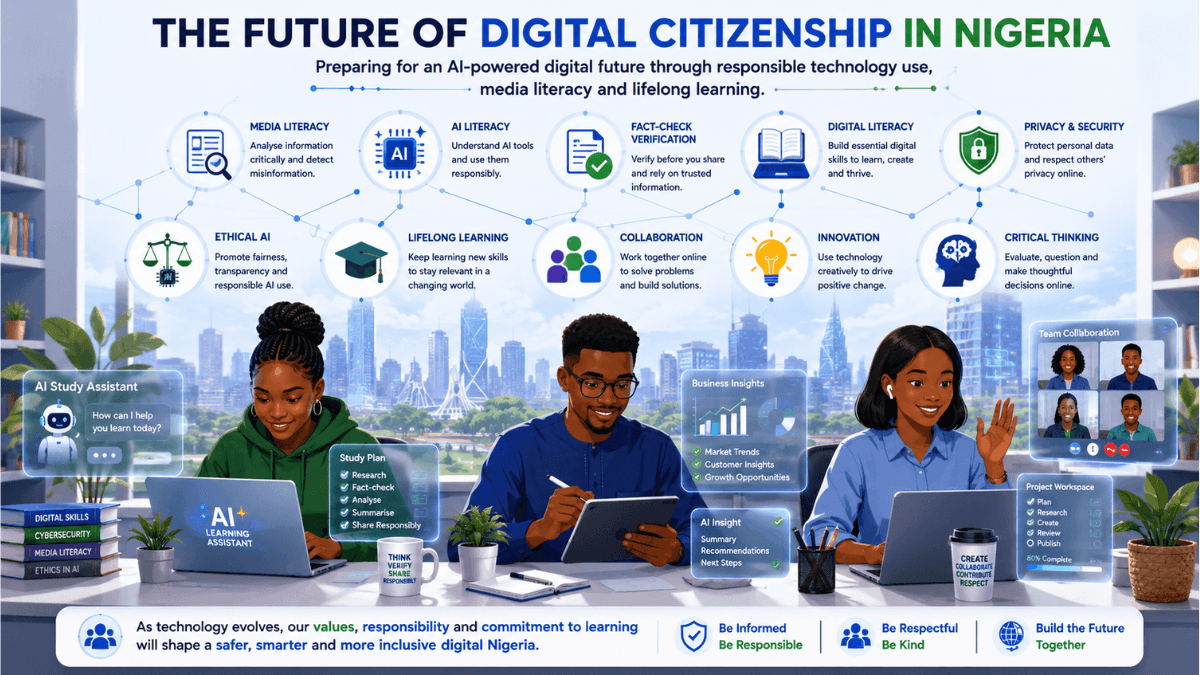
Technology will continue to evolve, and digital citizenship must evolve alongside it.
Artificial intelligence is already transforming how people search for information, create content, communicate, study and work. Deepfake videos, AI-generated voices and increasingly realistic digital content mean that future internet users will require even stronger critical-thinking and media-literacy skills.
At the same time, these technologies create enormous opportunities.
Students can receive personalised learning support.
Entrepreneurs can automate repetitive tasks.
Professionals can improve productivity.
Small businesses can serve customers more efficiently.
The challenge is no longer whether people should use artificial intelligence.
The challenge is learning to use it responsibly.
Responsible AI use is likely to become one of the defining characteristics of good digital citizenship over the coming decade.
As social media continues to influence how young Nigerians communicate, learn and build careers, responsible online behaviour becomes even more important. Many of these cultural changes are explored further in our article on How Social Media Is Shaping Youth Culture and Lifestyle in Nigeria.
Looking Ahead
Technology will continue to change, but honesty, respect, responsibility and critical thinking will remain the foundations of good digital citizenship.
Preparing for the future therefore means developing digital literacy, media literacy, AI literacy and ethical decision-making alongside technical skills.
Technology will continue to evolve.
Responsible people will determine whether that evolution benefits society.
Are You Practising Good Digital Citizenship?
Take a moment to reflect on your own online habits.
Can you honestly answer Yes to most of these questions?
- □ I verify information before sharing it.
- □ I think carefully before commenting online.
- □ I respect other people’s privacy.
- □ I ask permission before sharing someone else’s photographs, messages or personal information.
- □ I verify AI-generated content before trusting or sharing it.
- □ I protect my digital footprint.
- □ I avoid spreading rumours and misinformation.
- □ I report suspicious online activity whenever appropriate.
- □ I use technology intentionally rather than mindlessly.
- □ I continue learning about new technologies and digital skills.
The more boxes you can confidently tick, the stronger your digital citizenship habits are likely to be.
At a Glance
Table 2: Good Digital Citizen vs Poor Digital Citizen
| Good Digital Citizen | Poor Digital Citizen |
|---|---|
| Verifies information before sharing | Shares rumours without checking |
| Protects personal and others’ privacy | Overshares sensitive information |
| Thinks before posting | Posts impulsively |
| Communicates respectfully | Engages in cyberbullying or abusive language |
| Reports suspicious activity | Ignores scams or harmful behaviour |
| Continues learning | Resists learning and adapting |
Frequently Asked Questions
What is Digital Citizenship in Nigeria?
Digital Citizenship in Nigeria refers to using digital technologies responsibly, ethically and respectfully while participating in online communities. It involves making thoughtful decisions that protect your reputation, respect other people and contribute positively to the internet.
Why is digital citizenship important?
It helps build trust, reduce misinformation, strengthen online communities and prepare people to use digital technology responsibly in education, business and everyday life.
Is Digital Citizenship the same as Internet Safety?
No. Internet safety focuses on protecting people from online threats such as scams, phishing attacks and malware. Digital citizenship focuses on responsible online behaviour, ethical participation and respectful communication. The two concepts complement one another.
Can Digital Citizenship help reduce misinformation?
Yes. Responsible digital citizens verify information before sharing it, question suspicious claims, rely on credible sources and encourage others to do the same. These habits significantly reduce the spread of misinformation within digital communities.
What is a digital footprint?
A digital footprint is the collection of information created through your online activities, including comments, photographs, social media posts, searches and other digital interactions.
What are the principles of Digital Citizenship?
The core principles include responsible online behaviour, respectful communication, protecting privacy, verifying information, ethical technology use, continuous learning and contributing positively to digital communities.
How does Digital Citizenship help reduce online scams?
Responsible digital citizens verify suspicious messages, avoid forwarding fraudulent content, report fake accounts and encourage trustworthy online behaviour. These habits reduce opportunities for scammers to deceive more people.
Can poor online behaviour affect employment opportunities?
Yes. Many employers and professional organisations review applicants’ online presence. Irresponsible online behaviour can damage credibility, while a positive digital reputation can strengthen career opportunities.
How can students become better digital citizens?
Students can become better digital citizens by using AI responsibly, avoiding plagiarism, verifying information before sharing it, respecting classmates online and participating honestly in digital learning environments.
What role do parents play in teaching Digital Citizenship?
Parents help shape children’s digital habits by modelling responsible online behaviour, encouraging respectful communication and discussing online safety, privacy, misinformation and responsible technology use openly.
Why is digital literacy important today?
Digital literacy helps people evaluate information critically, recognise misinformation, adapt to emerging technologies and participate confidently in an increasingly digital society.
Conclusion
Every message we send, every comment we write and every piece of information we share contributes to the kind of digital society we create.
Technology alone cannot make the internet safer, more respectful or more trustworthy.
Responsible people do.
Practising responsible online behaviour is not about being perfect online. It is about making thoughtful choices every day—verifying information before sharing it, respecting other people’s privacy, communicating with courtesy, protecting your digital reputation and contributing positively to the communities you belong to.
As Nigeria’s digital economy continues to expand, these habits will become even more valuable. The internet offers extraordinary opportunities for learning, innovation, entrepreneurship and connection, but those opportunities flourish best when users combine digital skills with responsibility, integrity and respect.
Every responsible decision—no matter how small—helps shape the kind of internet that future generations of Nigerians will inherit. By becoming a better digital citizen today, you are helping to build a safer, smarter and more trustworthy digital future for everyone.
Continue Reading: